
The central locking fuse is an electrical protection component that cuts off power in case of overload on the door locking circuit. When this fuse blows, the remote control or central locking button no longer triggers anything, while the rest of the vehicle’s electronics function normally. Locating and replacing this part takes a few minutes, provided you know where to look and avoid two or three mistakes that turn a simple operation into a recurring breakdown.
Driver’s side fuse box or engine compartment: where to look depending on your model
Most cars have two fuse boxes. The first is located in the cabin, usually under the dashboard on the driver’s side, sometimes hidden behind a plastic cover that can be removed by hand. The second is housed in the engine compartment, protected by a clipped cover.
The central locking fuse is most often found in the cabin fuse box. On some Renault models, it can be identified by the diagram engraved on the cover of the box. Other manufacturers place this fuse in the engine compartment, without clear labeling.
To quickly identify the correct location, you can consult the central locking fuse on Carfully or refer to your vehicle’s owner’s manual, which indicates the exact position and amperage of each fuse.
On newer vehicles, the fuse dedicated to central locking has sometimes disappeared in favor of integrated protection directly within an electronic module. In this case, the diagnostic logic changes: it is no longer a matter of looking for a classic fuse but rather having the control unit checked.
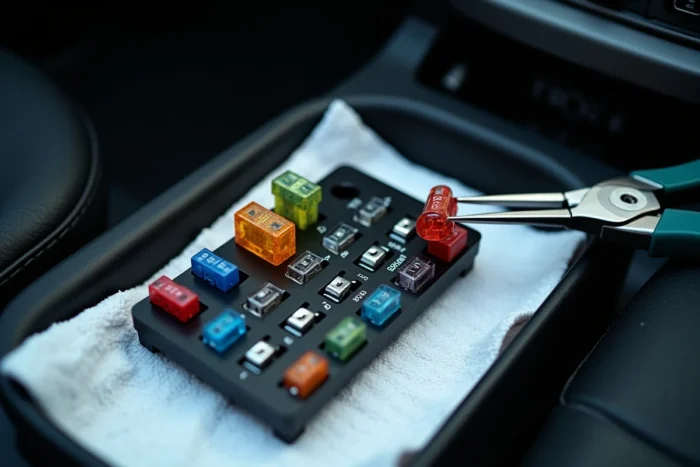
Testing the fuse with a multimeter: going beyond visual inspection
A blown car fuse sometimes shows a visibly broken filament through its transparent casing. This visual inspection is sufficient in most cases, but it is not reliable every time. Some fuses appear intact while the electrical continuity is broken.
Checking with a multimeter in continuity mode
Set your multimeter to continuity mode (diode symbol or sound wave). Place the two probes on the metal terminals of the fuse, on each side. The absence of a beep confirms that the fuse is blown, even if the filament appears visually intact.
This test takes a few seconds and prevents you from reinstalling a defective fuse thinking it works. If you do not have a multimeter, a fuse tester sold for a few euros at an auto parts store does the same job.
Replacing the central locking fuse: step-by-step procedure
Before any manipulation, turn off the ignition and remove the key (or disable the start on keyless models). Work in a well-lit area to clearly distinguish the colors and inscriptions on the box.
- Open the fuse box cover and locate the fuse corresponding to the central locking using the diagram or the owner’s manual.
- Remove the fuse with the extraction pliers provided in the box (a small plastic pliers often clipped to the cover). If not available, a pair of needle-nose pliers will suffice.
- Check the removed fuse: visual inspection followed by a multimeter test if necessary.
- Insert the replacement fuse, strictly adhering to the same amperage as the original. The color of the fuse corresponds to a specific gauge.
After insertion, immediately test the central locking with the remote control and the interior button. The doors should lock and unlock without delay.
Repeatedly blown fuse: identifying a downstream short circuit
A new fuse that blows immediately or within days does not indicate a fuse problem. A fuse that blows again indicates a short circuit downstream of the circuit, most often in the electrical harness of a door or in a stuck lock actuator.
Common causes of short circuits in the central locking circuit
The passage of wires between the body and the door is a zone of permanent flexing. Over time, the protective sheath wears out and a bare wire may come into contact with the metal. This defect causes a short circuit that the fuse absorbs by blowing.
A stuck or end-of-life lock motor (actuator) draws an abnormally high current. The fuse blows to protect the electrical circuit, preventing overheating of the wiring.
In both cases, replacing the fuse with a higher gauge is a serious mistake. A higher-rated fuse will not blow, but it will allow excessive current to pass, which can damage the harness or cause a fire. Always respect the original amperage indicated on the box diagram.
Fuse not found on recent vehicle: when the diagnosis changes
On some models produced in recent years, the central locking circuit is protected by an integrated protection in the electronic body module (BSI, BCM, or equivalent depending on the manufacturer). No removable fuse is accessible in the standard box.
If your search in both boxes yields nothing and the manual does not mention any fuse dedicated to central locking, the failure likely lies with the module itself. An electronic diagnostic scan then becomes necessary to read the fault codes and guide the repair.
This type of intervention goes beyond replacing a fuse and requires specific tools. Before making an appointment, check the remote control battery: a weak battery produces exactly the same symptoms as a blown fuse, without any electrical component of the vehicle being at fault.