
We are in the middle of preparing a cake, the recipe states “1/4 liter of milk,” and we find ourselves in front of the countertop with a measuring cup in centiliters. No scale, no measuring cup in liters.
This kind of situation arises as soon as we come across an old family recipe or a cookbook that uses fractions of a liter. The conversion is simple, but it poses a real practical problem when we don’t have it in mind.
Reading fractions of a liter without a measuring cup or scale
Most kitchen containers display graduations in centiliters or milliliters. Recipes, on the other hand, often refer to quarters, thirds, or half-liters. The discrepancy between the two creates hesitation that slows down the preparation.
The basic rule can be summed up in one operation: 1 liter equals 100 centiliters. From there, all fractions can be calculated mentally.
- 1/2 liter = 50 cl (half of a standard water bottle)
- 1/4 liter = 25 cl (a large standard water glass)
- 1/3 liter = about 33 cl (a soda can)
- 1/8 liter = 12.5 cl (a small table glass)
There’s no need to pull out a calculator. Just associate each fraction with a common container that you already have in the cupboard. A standard mustard glass holds about 25 cl when filled to the brim, which corresponds exactly to 1 quarter liter in cl for your most common recipes.
For eighths of a liter, simply divide the mustard glass in half. This mental exercise becomes automatic after two or three uses.
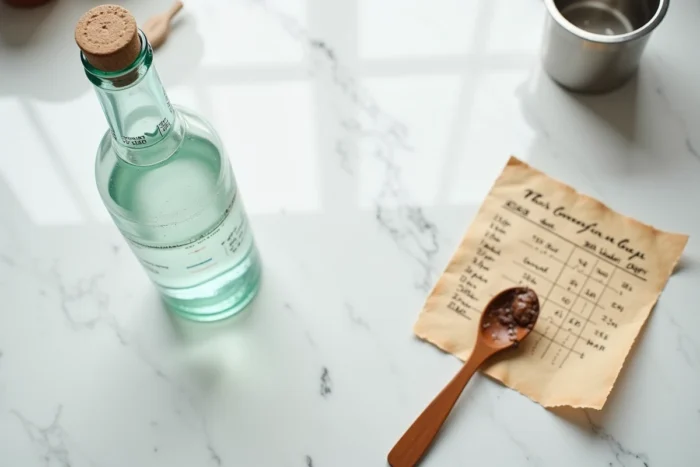
Conversion to centiliters: why recipes mix units
One might think that all recipes use the same system. In practice, the formats vary depending on the time period and the origin of the text. French cookbooks from before the 1980s favor fractions of a liter. More recent sheets prefer centiliters or milliliters, based on the graduations of commercially sold utensils.
Anglo-Saxon recipes add a layer of complexity with “cups” and “tablespoons.” When translating an American book, the cup is close to a quarter liter but does not correspond exactly. The difference remains negligible for a cake or a sauce.
The real trap comes from recipes that mix the two systems in the same ingredient list: “1/4 liter of cream, 200 ml of milk, 15 cl of broth.” You end up juggling between three scales. The most effective solution is to convert everything to centiliters before starting, noting the equivalents in pencil directly on the recipe.
Liquid conversion and dry ingredients: a difference that changes the dosage
The conversion 1 quarter liter = 25 cl works perfectly for water, milk, broth, or cream. For liquids, volume and weight correspond roughly: 25 cl of water weighs about 250 g.
With dry ingredients, the logic collapses. Flour, powdered sugar, or almond powder have very different densities. A quarter liter of flour does not weigh 250 g. It weighs significantly less because flour contains a lot of air between the particles.
This is why serious baking recipes indicate dry ingredients in grams and liquids in volumes. If a recipe calls for “1/4 liter of flour,” it is an approximate guideline. In this case, it’s better to weigh with a scale rather than fill a measuring cup.
When volume-weight conversion remains reliable
For water-based liquids (milk, juice, vinegar, wine), the correspondence 25 cl = 25 cl regardless of the container poses no problem. Oil is slightly lighter than water, but the difference remains negligible in a home cooking recipe.
Feedback varies on this point for very technical preparations like professional baking, where a difference of a few grams alters the final texture. For everyday use, conversion to centiliters is more than sufficient.

Quick conversion table: fractions of a liter to centiliters and milliliters
Rather than recalculating each time, you can keep this table displayed near the countertop.
| Fraction of a liter | Centiliters (cl) | Milliliters (ml) |
| 1/8 liter | 12.5 cl | 125 ml |
| 1/4 liter | 25 cl | 250 ml |
| 1/3 liter | 33.3 cl | 333 ml |
| 1/2 liter | 50 cl | 500 ml |
| 3/4 liter | 75 cl | 750 ml |
| 1 liter | 100 cl | 1,000 ml |
This table covers almost all the fractions encountered in French recipes. Tablespoons and teaspoons belong to another measurement category, but they also convert easily: a tablespoon contains about 1.5 cl, a teaspoon about 0.5 cl.
Express method to convert any fraction of a liter
The technique consists of a single mental operation. Take the denominator of the fraction (the bottom number), and divide 100 by that number.
- 1/4 liter: 100 divided by 4 = 25 cl
- 1/3 liter: 100 divided by 3 = 33.3 cl
- 1/5 liter: 100 divided by 5 = 20 cl
- 3/4 liter: first calculate 1/4 (25 cl), then multiply by 3 = 75 cl
This method works for all fractions, even the rarer ones like 1/6 liter (about 16.7 cl) that we sometimes encounter in cocktail recipes.
The most useful reflex remains to identify your own reference containers and check their exact capacity once. A bowl, a mug, a mustard glass: three reference points are enough to cover the majority of measurements without pulling out measuring equipment.