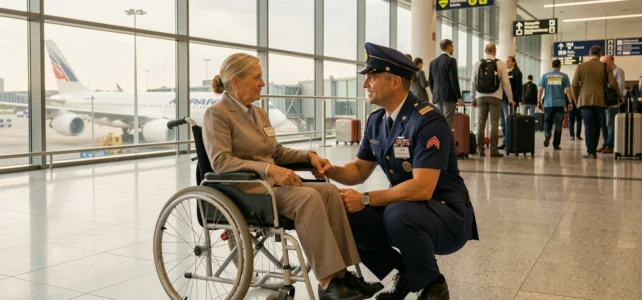
The SAPHIR program of Air France remains the single point of entry for any request for assistance related to a motor, sensory, or cognitive disability. We find that the majority of malfunctions reported by passengers stem from a failure of upstream communication, not from a lack of equipment. Understanding the pricing and logistical mechanisms helps avoid blockages on the day of departure.
Compensation limits for wheelchairs and mobility aids in the hold
The Montreal Convention classifies wheelchairs and technical aids as checked baggage. As of December 28, 2024, the liability limit has been raised to 1,519 SDR per passenger, up from 1,288 SDR previously. This increase enhances the potential coverage in case of destruction, loss, damage, or delay of equipment transported in the hold.
In practice, this limit remains insufficient for a high-end electric wheelchair, the value of which often exceeds this amount. A proposed revision of air passenger rights in the EU stipulates that the airline will have to cover the full cost of repair or replacement, without limitation to the Montreal ceiling. This text is not yet in effect, but it will significantly change the liability of carriers.
We recommend photographing the wheelchair from all angles before check-in and keeping the purchase invoice or replacement quote. In case of damage noted upon arrival, the declaration must be made immediately at the counter, then confirmed in writing within seven days. Regarding the Air France pricing and assistance for disabilities, the free transport of the wheelchair in the hold is confirmed in addition to the usual baggage allowance.
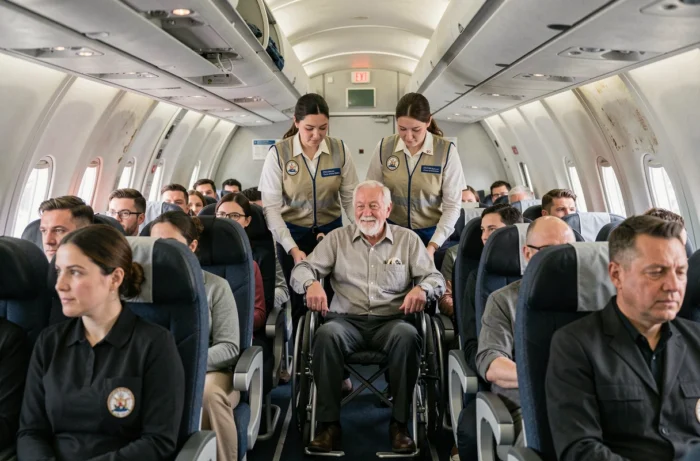
Obligation for free placement of the accompanying person on Air France
The European project for revising passenger rights also requires airlines to guarantee free seating side by side for the passenger and their companion. Air France partially anticipates this obligation through the SAPHIR program, which allows for the notification of an accompanying person at the time of booking.
In terms of pricing, the companion pays for their ticket at the standard rate. No specific discount is applied by Air France on the companion’s ticket price, contrary to what some passengers assume. The free aspect only concerns the allocation of the adjacent seat, not the transport itself.
When the MEDIF medical agreement becomes mandatory
The MEDIF (Medical Information Form) is required in specific situations:
- Transport of medical oxygen or use of a portable concentrator (POC) in the cabin, with model validation by Air France’s medical service
- Passenger on a stretcher or requiring a lying position, which involves reserving multiple seats
- Recent or progressive pathology likely to worsen at altitude, particularly severe respiratory failure or surgery less than ten days old
- Need for intravenous injection or any medical procedure during the flight
The MEDIF must be returned at least 48 hours before departure. We observe that boarding refusals related to disability almost always result from an incomplete or late MEDIF submission.
Inclusion mobility card and airport journey: what changes concretely
The inclusion mobility card (CMI) mentioning “disability” or “priority” does not trigger any fare reduction with Air France. Its utility lies exclusively in the airport journey: priority access to check-in lines, early boarding, and quick identification by ground assistance agents.
The request for assistance must be registered in the booking, not at the counter on the day of departure. The CMI alone is not sufficient to activate the SAPHIR system. Ground agents cannot improvise unplanned assistance, especially for an electric wheelchair that requires a specific loading protocol.
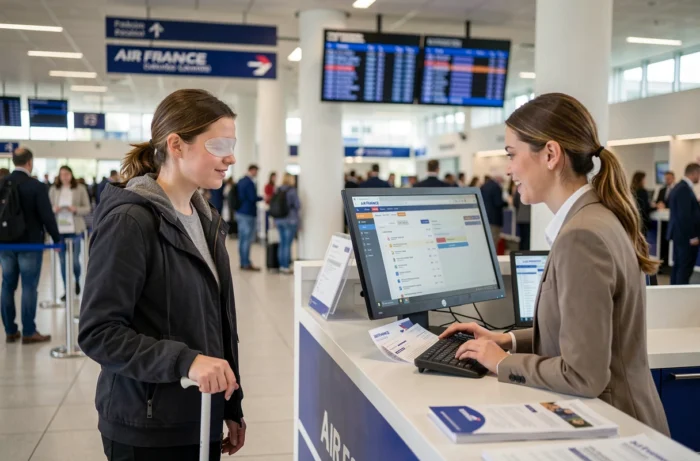
Assistance codes and their impact on the service received
Each type of disability corresponds to an IATA code recorded in the booking file (PNR). These codes determine the level of service:
- WCHC: totally immobile passenger, requires complete assistance to the cabin seat
- WCHS: passenger able to climb stairs but not to cover long distances
- WCHR: autonomous passenger on board but requiring a wheelchair for distances in the terminal
- BLND and DEAF: passengers with visual or hearing impairments, orientation and communication assistance provided
An incorrectly entered code leads to a mismatch between the actual need and the service provided. The WCHC code implies a transfer by ambulift on aircraft without a jet bridge, which requires coordination with the airport ground services. This point is often underestimated at regional stops.
Booking adapted seating and cabin technical constraints
Seats with movable armrests are not available on all rows. On Air France long-haul aircraft, rows close to accessible toilets are prioritized for WCHC passengers. This allocation is done through SAPHIR, not through the self-service cabin plan.
Passengers with disabilities cannot be seated in emergency exit rows. This regulatory restriction also applies to companions when they need to provide physical assistance during the flight.
On flights operated under code share by partner airlines (KLM, Delta, Korean Air), the level of assistance may vary. The SAPHIR program transmits the codes to the partner, but each airline applies its own operational procedures on the ground. We recommend reconfirming assistance directly with the operating airline when the flight is not operated by Air France.
The transport of lithium-ion batteries for electric wheelchairs follows IATA regulations on dangerous goods. Batteries exceeding 300 Wh require prior approval from the carrier. The battery must be disconnected, its terminals protected, and the wheelchair set to transport mode before being handed over to the hold.
The assistance chain remains effective when each link is activated upstream. The critical point is never the ticket price, but the quality of the information transmitted at the time of booking.