A leaking shower hose, a kitchen faucet that drips at night, a toilet that continuously runs: we often discover the plumbing in our home when it becomes a problem. Water damage is now the most common household disaster in France. Understanding the basics of plumbing allows you to identify an issue before it becomes an emergency and to communicate effectively with a professional when intervention is necessary.
Locate the shut-off valve and the meter before any intervention
When a pipe bursts or a fitting fails under a sink, the first action to limit damage is not technical: it is to turn off the water. You then look for the main shut-off valve, often located near the meter, in a utility closet, garage, or an outside access point.
Identifying this shut-off point in advance, before any emergency, prevents you from wading through water while searching for a rusty handle behind a piece of furniture. Testing the shut-off valve once a year ensures that it still turns freely. A valve left open for years can seize up due to corrosion or limescale, becoming unusable when you need it.
The meter, on the other hand, acts as a watchdog. You note the reading before going to bed, and check it the next morning without using any water in between. If the number has changed, there is a leak somewhere in the internal network. This is a free and reliable diagnosis that you can perform yourself. To delve deeper into the basics of plumbing on Une Autre Maison, this type of check is a good starting point.
Copper, PEX or multilayer: choosing the right material for your network
The pipes in a house are not all made of the same material, and each type of pipe serves a specific purpose. Confusing a supply pipe with a drainage pipe, or connecting two incompatible materials, can cause leaks or premature corrosion.
Water supply: copper, PEX, and multilayer
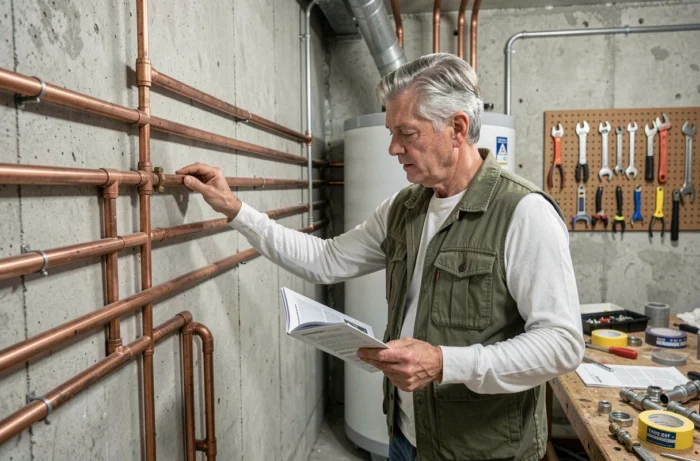
Copper remains the historical material for drinking water networks. It withstands pressure well, endures high temperatures, and lasts for several decades. However, its installation requires soldering (brazing), a torch, and a minimum level of skill.
PEX is gradually replacing copper in new installations and renovations. More flexible, it bends easily and connects without soldering thanks to crimping or slip systems. The multilayer pipe, derived from PEX with an integrated aluminum layer, offers better shape retention and enhanced sealing but requires specific tools.
Drainage: PVC and mandatory slope
For wastewater, PVC dominates. It has replaced lead (banned due to its toxicity) and cast iron in the majority of homes. One often overlooked point: the drainage slope must remain between 1 and 3 cm per meter. If it is too shallow, water stagnates and deposits accumulate. If it is too steep, water flows without carrying solid materials, leading to repeated blockages.
- Copper: suitable for hot and cold water supply, requires brazing, long lifespan.
- PEX: flexible, without soldering, suitable for renovations and wall passages.
- Multilayer: intermediate rigidity, good sealing, dedicated tools required.
- PVC: reserved for drainage, simple bonding, does not withstand hot water under pressure.
Fittings and faucets: the parts that leak first
The majority of household leaks do not come from a burst pipe. They occur at junctions: threaded fittings, faucet seals, supply hoses. These are the parts most mechanically stressed and the first to wear out.
A poorly tightened fitting or a crushed flat seal is enough to cause a discreet leak that damages the cabinet under the sink for months. Checking the condition of hoses every five years significantly reduces this risk. Braided rubber hoses age: the inner rubber cracks, the braiding masks the degradation, and the rupture occurs without warning.
For faucets, two mechanisms coexist in homes. Compression faucets (older models with two handles) use a rubber seal that deforms over time, causing the classic drip. Cartridge mixers are more durable, but when the cartridge wears out, the entire block must be replaced. Returns vary on the exact lifespan, as it depends heavily on the hardness of the local water.
Backflow prevention device and siphon: the sanitary safety of the domestic network
The sanitary aspect of plumbing is rarely discussed, and that is a mistake. The drinking water network of a house can be contaminated by a backflow phenomenon when a drop in pressure in the public network sucks wastewater back into the clean circuit.
Since the decree of September 10, 2021, backflow prevention devices are regulated by strengthened regulations. A guide published in December 2025 by Astee specifies the obligations for networks installed or renovated since January 2023. Protection must apply at the delivery point, on the take-offs of the internal network, and at the level of the equipment.
A sanitary file, including a diagram of the networks and the location of devices, must be maintained and updated.
The siphon, on the other hand, plays a more familiar role. This bend filled with water under each sink or basin prevents sewer gases from rising into the room. A dried-out siphon allows foul odors to pass through: this is common in sinks or showers that have not been used for several weeks. Pouring a glass of water down the drain is enough to restore the hydraulic seal.
- Backflow preventer: to be checked regularly, mandatory on recent installations, protects the network against contamination.
- Siphon: to be cleaned every three to six months to prevent the accumulation of residues and bad odors.
- Primary ventilation: the pipe that opens onto the roof balances pressure in the pipes and prevents siphoning.
Maintaining your plumbing does not require training or expensive tools. Locating the shut-off valve, inspecting hoses, cleaning siphons, and monitoring the meter already cover the vast majority of common problems. The rest is the plumber’s job, but we make their work easier by being able to describe precisely what is happening in our pipes.