
The red light on your Bosch Tassimo is on, and you have neither descaling tablet nor service T-disc on hand. Limescale, however, does not wait: it deposits on the heating element and in the hydraulic circuit with every cup. Several natural solutions allow for effective descaling of the Bosch Tassimo without resorting to the chemicals sold by the brand, provided that a few precautions are followed.
Limescale in a Bosch Tassimo: what really happens in the circuit
You may have noticed that the coffee flows more slowly after a few weeks of use? The culprit is calcium carbonate, a mineral residue present in tap water. It settles on the internal walls of the machine, particularly on the heating element and narrow pipes.
Using filtered water reduces chlorine and suspended particles, but home filters do not remove all dissolved minerals. Calcium and magnesium partially pass through. A Tassimo supplied with filtered water therefore accumulates limescale, just a little more slowly.
Another often misunderstood point: unplugging the machine does not reset the descaling light. This light remains on until the complete descaling program has been executed. The descaling of Bosch Tassimo without a tablet follows the same logic as the official cycle, with a different acid.
Food-grade citric acid: the natural descaler suitable for the Tassimo
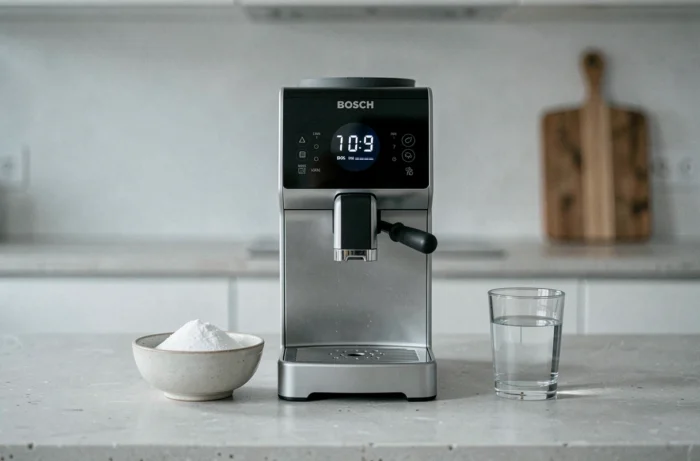
The tablets sold by Tassimo mainly contain citric acid or lactic acid. Reproducing this base at home is simple. Food-grade citric acid, available at health food stores or drugstores, does exactly the same job.
Its mechanism is straightforward. Citric acid reacts with calcium carbonate to form calcium citrate, a compound soluble in water. During rinsing, everything is flushed out. Citric acid is less aggressive than white vinegar on the seals and internal components of the machine.
To prepare the solution, here are the steps:
- Fill the water tank with lukewarm water (not boiling, to avoid damaging the plastic of the tank).
- Dissolve one to two tablespoons of food-grade citric acid in the tank until fully dissolved.
- Start the descaling cycle via the on/off button held for a few seconds, or manually pass the solution if you do not have the service T-disc.
- Then rinse the circuit by running at least three to four tanks of clear water to eliminate any traces of acid.
Rinsing is the longest and most overlooked phase. Insufficient rinsing leaves a persistent acidic taste in subsequent drinks. Better to rinse too much than too little.
White vinegar and Tassimo: why this solution poses a real taste problem
White vinegar is the most common reflex for home descaling. It works well on a kettle or a drip coffee maker. On a Bosch Tassimo, it’s more complicated.
The hydraulic circuit of a Tassimo is compact, with narrow pipes and silicone seals. Vinegar can leave a stubborn smell and taste even after several rinsing cycles. Some users report needing to run five to six tanks of clear water before getting back to neutral coffee.
The acetic acid in vinegar is also more aggressive than citric acid on elastomer seals. In the long term, repeated descalings with vinegar can weaken the tightness of the circuit. If you really only have vinegar on hand, dilute it further and multiply the rinses. Citric acid remains the safest choice.
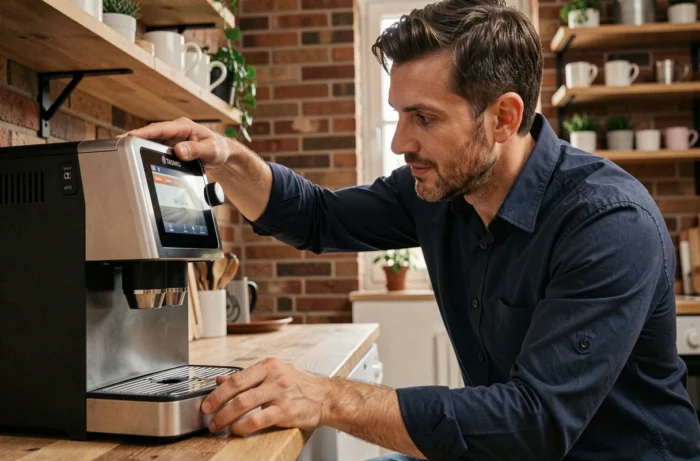
Descaling Tassimo without service T-disc: starting the cycle manually
The yellow T-disc (or service disc) contains a barcode that triggers the automatic descaling program. Without this disc, the machine does not recognize the descaling command. You have two options.
The first: circulate the descaling solution without the automatic program. Fill the tank with the citric acid solution, place a container under the nozzle, and start a cycle as if you were preparing a drink, but without a pod. The machine will pass the water through the circuit. Repeat the process until the tank is empty, then rinse thoroughly.
The second: obtain a replacement T-disc. Bosch sometimes provides them for free through customer service. You can also find them online for a few euros. The T-disc does not wear out and can be reused for each descaling.
Cleaning removable parts: the step that descaling does not replace
Descaling addresses mineral deposits in the internal circuit. Coffee residues, oils, and organic deposits accumulate elsewhere: in the brewing chamber, on the filter, in the drip tray, and on the cup holder.
These two operations are complementary, not interchangeable. A rinse with clear water after descaling does not clean the removable parts. Here’s what to do regularly:
- Remove the cup holder and drip tray, wash them in warm soapy water.
- Clean the filter of the brewing chamber with a soft brush to dislodge dried coffee residues.
- Wipe the outlet nozzle with a damp cloth to prevent the accumulation of greasy deposits.
Regular maintenance of these parts prevents coffee oils from going rancid and altering the taste of your drinks, regardless of limescale.
The frequency of descaling directly depends on the hardness of the water in your area. Very hard water requires more frequent descaling, sometimes every three to four weeks with daily use. The red light on the machine remains the best indicator, provided you do not ignore its signal by simply unplugging it.