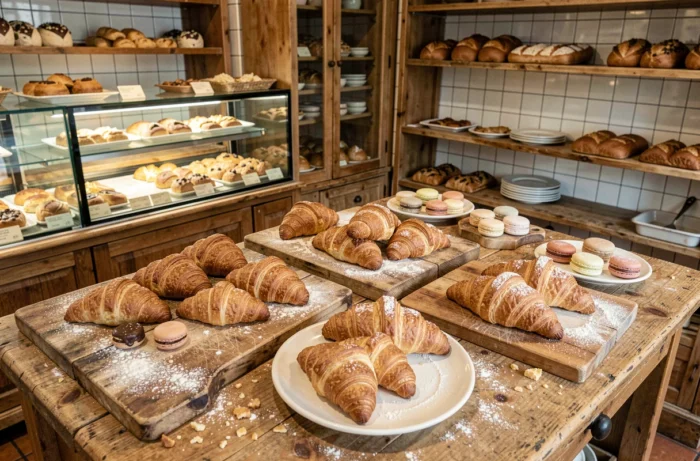
When you push open the door of an artisanal pastry shop on a Saturday morning, the choice is paralyzing: Paris-Brest, chocolate éclair, lemon meringue tart. The same hesitation strikes in front of an Italian tiramisu or a Japanese mochi. French and international treats abound, but not all deserve the same attention. Some rely on precise technical know-how, while others depend on a rare ingredient or a balance of textures that is difficult to replicate.
Artisans and local shops: where to find the best pastries
Competitors list desserts without ever mentioning the purchasing channel. Yet this is where everything is at stake. In 2025, specialized food shops and commercial artisans (pastry shops, chocolatiers, ice cream makers) saw their sales increase by about 4% in volume, while hypermarkets continued to decline for the fourth consecutive year.
This shift changes the game for those seeking quality treats. A chocolate éclair bought from a neighborhood pastry chef is nothing like its industrial counterpart in a plastic tray. The pastry cream is cooked in the morning, the ganache is measured by hand, and the glaze is shiny because it hasn’t spent three days in a cold room.
This dynamic can be found on monde-gourmandises.net, which lists sweet and savory specialties from this artisanal fabric, both in France and abroad. The reflex to search for a food product online before heading out follows the same logic as reserving a table: we want to know what we will find.

Crème brûlée, Paris-Brest, tarte Tatin: what distinguishes a successful French dessert
An iconic French dessert almost always relies on a contrast of textures. Crème brûlée contrasts a layer of crunchy caramelized sugar with a creamy vanilla custard. The Paris-Brest plays on the crispy choux pastry against the rich praline mousseline cream. The tarte Tatin derives its flavor from the caramel formed by the inverted cooking of the apples.
What separates a mediocre version from a successful one often comes down to an execution detail:
- For crème brûlée, the quality of the vanilla and the exact cooking temperature in a water bath determine the final consistency – overcooked, it becomes grainy.
- The Paris-Brest requires homemade praline paste (roasted and ground almonds and hazelnuts), not an industrial praline that drowns the flavor in sugar.
- The tarte Tatin demands apples that hold up during long cooking without turning into applesauce, and a caramel cooked far enough to avoid bitterness without remaining bland.
These same requirements are found in Parisian macarons: the shell must be smooth, with a well-formed foot, a sign that the macaronnage (the mixing of meringue and almond flour) has been mastered. A failed macaron is identified by its cracked surface or lack of foot.
Tiramisu, mochi, pastel de nata: international treats worth the detour
Tiramisu is experiencing a notable resurgence in popularity worldwide. This Italian dessert, which layers coffee-soaked biscuits, mascarpone, and cocoa, now comes in versions with pistachio, strawberries, or lemon. Its strength lies in the fact that it requires no cooking and forgives approximations, which explains its success both at home and professionally.
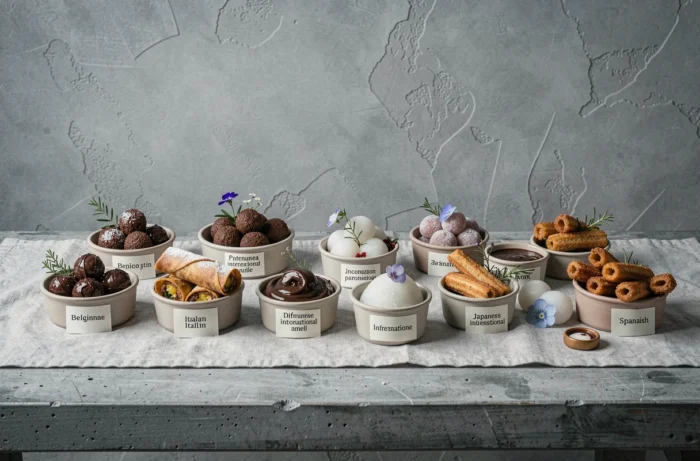
The Japanese mochi occupies a completely different register. This glutinous rice dough wraps a filling (red bean paste, ice cream, cream) in an elastic texture that has no equivalent in Western pastry. Reactions vary on this point: some love this chewy consistency, while others find it puzzling on the first try.
The Portuguese pastel de nata, on the other hand, relies on simplicity. A base of puff pastry, an egg cream caramelized by the oven. The contrast between the crispy puff pastry and the still-wobbly flan in the center is everything. It is dusted with cinnamon or powdered sugar and is best enjoyed warm, ideally taken out of the oven less than an hour ago.
Three lesser-known specialties to look out for
The Swedish kanelbullar (cinnamon bun, popularized as the cinnamon roll) offers a remarkable pleasure-to-effort ratio for those who bake at home. The kashata, an African confection made from coconut, brings a sweet-crunchy dimension absent from European traditions. The Brazilian quindim, a small dense flan made with egg yolks and grated coconut, surprises with its compact texture and pronounced caramelized egg flavor.
Frozen desserts in France: a market bouncing back
After two years of volume decline, the ice cream market in France saw a significant rebound in 2025, with an increase of about 8 to 9% in volume and around 10% in revenue. Exceptional weather conditions played a role, but the underlying trend goes beyond the thermometer.
Artisanal frozen desserts are growing faster than industrial products. Here we see the same movement as with dry pastries: consumers are turning to the neighborhood ice cream maker, the specialized shop, the short supply chain. A fresh fruit sorbet prepared in the morning does not have the same aromatic density as a tub from the supermarket that has been stored for weeks.
This rebound in frozen desserts also benefits hybrid recipes. The mochi ice cream, for example, combines the Japanese tradition of glutinous rice with an ice cream filling, and is now sold in most fine grocery stores in France.
Choosing a treat, whether French or international, ultimately comes down to identifying a balance: the quality of the main ingredient, the mastery of the technical gesture, and the freshness of the finished product. A Paris-Brest eaten on the day it is made at an artisan’s shop is worth all the rankings in the world. A pastel de nata taken out of the oven ten minutes ago renders any discussion about the best Portuguese dessert unnecessary. The treat is judged by the first bite, not by its reputation.