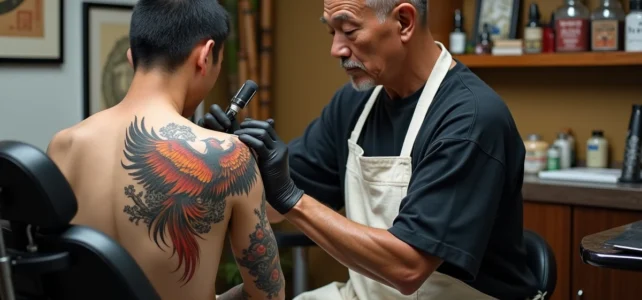
The Japanese phoenix tattoo is not just a firebird rising from its ashes. The Hō-ō, a composite creature inherited from the Chinese fenghuang and then reinterpreted by Japanese culture, carries a visual and symbolic coding that traditional irezumi treats with precise rigor. Understanding this coding changes the interpretation of a tattooed piece.
Hō-ō and Empress: A Gendered Polarity Absent from the Western Phoenix
In Japanese imperial iconography, the Hō-ō functions in tandem with the dragon. The dragon (ryū) embodies the masculine and the emperor, while the Hō-ō is associated with the empress and the feminine. This gendered distribution is specific to Japan and China and is not found in the Greco-Roman tradition of the phoenix, where the bird is simply a cyclic solar symbol.
In irezumi, this polarity has direct consequences on the composition. A full back piece (sōshinbori) combining dragon and phoenix does not superimpose two equivalent figures: it contrasts two complementary principles, much like yin and yang. We observe that this interpretation is often lost in Western adaptations, where the phoenix is treated as an autonomous motif without a counterpart.
To delve deeper into the meaning of the phoenix tattoo on Oh my shoe, one must keep in mind this dual dimension that structures the entire mythological repertoire of Japan applied to the skin.
Anatomy of the Hō-ō in Irezumi: Composite Elements and Representation Codes
The tattooed Japanese phoenix is not a simple stylized bird of prey. Its morphology borrows from several animals according to precise conventions passed down by master tattoo artists.
- The head resembles that of a golden pheasant, with a characteristic crest and a slender beak, never the hooked beak of an eagle.
- The neck is elongated, covered in scales reminiscent of a snake, which immediately distinguishes the Hō-ō from the Western phoenix with smooth plumage.
- The tail feathers are directly inspired by the peacock, with eye-patterned motifs fanned out.
- The claws are those of a bird of prey, often depicted grasping paulownia flowers (kiri) or chrysanthemums.
Each element has a symbolic function. The snake scales indicate belonging to the celestial and aquatic realms, not the terrestrial world. The paulownia is the quintessential imperial tree, and its association with the Hō-ō reinforces the connection to the imperial court.
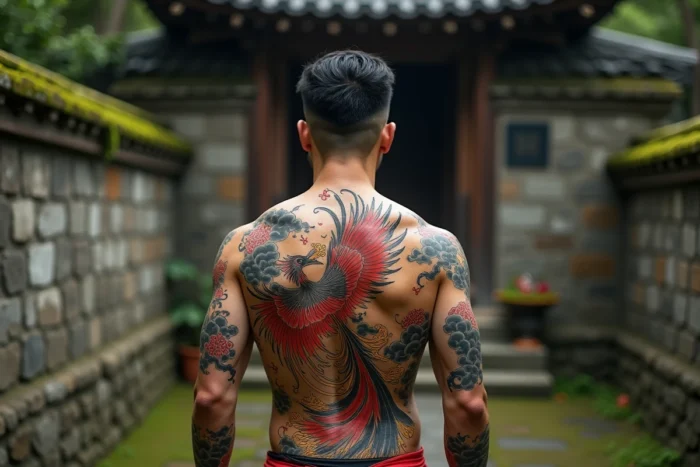
In terms of color palette, traditional tattoo artists work the Hō-ō in deep reds, oranges, and golds, but also in blues and greens for the secondary feathers. A Hō-ō that is exclusively red and orange often betrays a Western influence rather than an orthodox Japanese reading.
The Hō-ō Beyond Myth: Presence in Japanese Official Heritage
Competing articles confine the Japanese phoenix to mythology. However, the Hō-ō is a state motif, embedded in everyday objects and classified monuments.
The Byōdō-in temple in Uji houses the famous Hōōdō, the “Phoenix Hall,” topped with two bronze Hō-ō on its roof. This temple has been a UNESCO World Heritage site since 1994 as part of the historical monuments of ancient Kyoto.
The Hō-ō from Byōdō-in appears on the 10,000 yen bill, making it probably the most frequently seen image of a phoenix in the world on a daily basis. The 10 yen coin, on the other hand, represents the structure of the temple itself.
This inscription in currency and national heritage gives the Hō-ō tattoo a significance that the Greco-Roman phoenix does not have. A Hō-ō tattoo can be read as a symbol of national continuity, not just as a motif of personal rebirth. This is a distinction we recommend clarifying with the client before composing the piece.
Placement and Composition: Technical Constraints of the Phoenix in Irezumi
The Hō-ō is a demanding motif in terms of surface area. The fanned tail and outstretched wings require generous space to maintain their readability. The full back remains the canonical placement, but the side (from the hip to the armpit) and thigh offer suitable surfaces.
On an arm, the phoenix loses its majesty. The tail feathers compress, and the details of the cervical scales become unreadable from a distance. A full sleeve (hikae extended into nagasode) can work if the composition wraps the Hō-ō around the arm in a spiral, but this requires a mastery of flow that few Western tattoo artists possess.
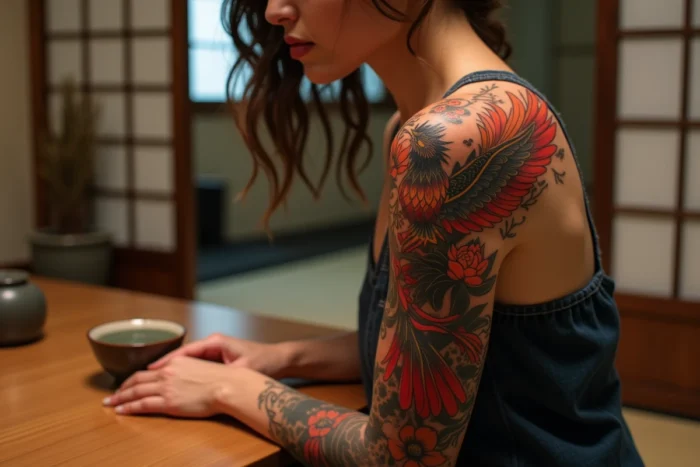
The background plays a structuring role. In traditional irezumi, the Hō-ō is set against a background of clouds, waves, or flames that are not decorative but narrative. The clouds signal the descent from the sky in times of peace. The flames indicate transformation. The waves, rarer, connect the motif to the aquatic world and reinforce the dialogue with the dragon.
- Cloudy background (kumo): peace, celestial descent, restored harmony
- Flame background (hi): transformation, purification, active renewal
- Wave background (nami): complementarity with the dragon, balance of elements
A Hō-ō without a background, placed on bare skin, is technically an incomplete motif from the perspective of irezumi grammar. It can work in an assumed neo-Japanese style, but it strays from tradition.
Tebori or Machine: Impact on the Rendering of the Hō-ō
The execution technique significantly alters the reading of a Japanese phoenix. The tebori (hand tattooing with needles mounted on a wooden handle) produces softer color gradients and a gradual saturation that the machine struggles to replicate exactly.
On a motif like the Hō-ō, where transitions between scales, feathers, and flames are numerous, tebori allows for more organic blends. The machine, on the other hand, excels at contour lines (sujibori) and dense black fills. Many contemporary Japanese tattoo artists combine both techniques on the same piece, reserving tebori for gradient areas and the machine for structural lines.
The choice of technique is not solely aesthetic. It also affects the duration of sessions, healing, and color retention over several decades. A complete Hō-ō in tebori on the back requires a commitment of several years between the tattoo artist and the wearer, which aligns with the very symbolism of the motif: patience, slow transformation, a result that transcends the moment.