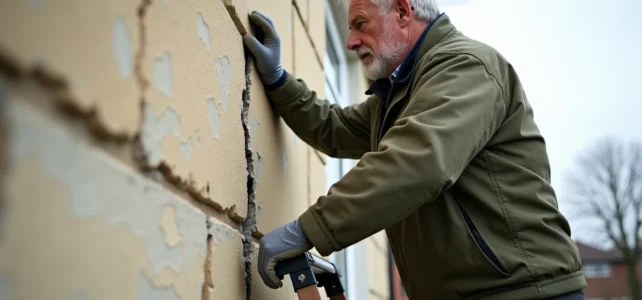
The repeated freeze-thaw cycles of a rainy winter put stress on facades well beyond what most single-layer coatings are designed to absorb. Water infiltrates the pores, freezes, expands the material, and then releases microcavities that enlarge with each new cycle. Spotting these damages early after the cold season determines the cost and complexity of the repair.
Capillary rise and lateral infiltrations: distinguishing two different mechanisms
The signs of moisture at the base of the facade do not all fall under the same diagnosis. A capillary rise progresses from the ground upwards, rarely beyond one meter, and leaves a regular front of whitish saline efflorescence. A lateral infiltration, caused by a waterproofing defect at the wall-terrace junction or a splashback from a gutter, produces a localized, often asymmetrical halo.
Confusing the two leads to treating a symptom without resolving the cause. We frequently observe water-repellent treatments applied to capillary rises, which worsens the situation by trapping moisture in the wall. The correct sequence is to first identify the source of the water before choosing a treatment.
Consulting a facade crack expert allows for a reliable diagnosis of the exact nature of the infiltration and avoids counterproductive interventions.
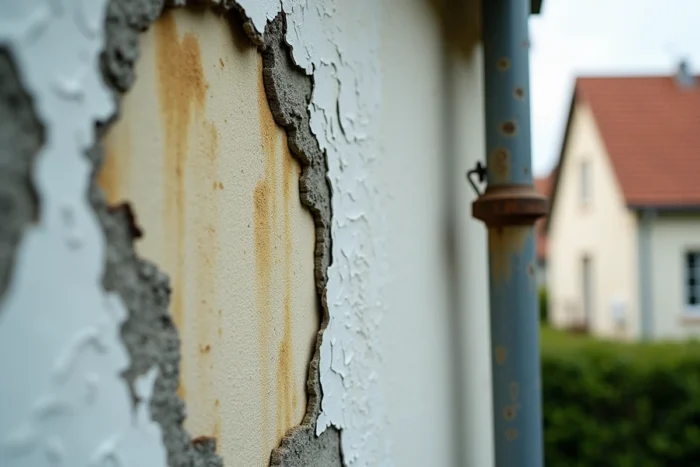
Post-winter cracks on facades: field reading and classification
Not all cracks require the same urgency. After a rainy winter, three categories deserve distinct attention in the field.
- Microcracks of shrinkage, less than a tenth of a millimeter, form a spider web pattern on the coating. They are superficial and require a flexible treatment (waterproofing coating of class I2 or I3).
- Linear cracks following the masonry joints or opening angles indicate structural movement. Their width often exceeds several tenths of a millimeter and they sometimes penetrate the coating down to the substrate.
- Stair-step cracks on block or brick walls indicate differential settling, exacerbated by water variations in the soil during a very rainy winter. They require monitoring with a witness (gauge or crackmeter) before any repair.
We recommend placing witnesses on structural cracks as early as spring and only filling them after stabilization, or risk seeing the crack reappear within a few months. Repairing an active crack amounts to masking a structural defect.
Diagnosis of facade joints and singular points after a rainy winter
Expansion joints, window frames, and facade-roof connections concentrate the majority of infiltrations after the cold season. The joint sealant ages faster than the surrounding coating, and a single rainy winter is enough to turn a slightly hardened joint into a point of water entry.
The screwdriver test remains a reliable indicator. Run the tip along the joint: if the sealant crumbles or detaches from the substrate without resistance, the joint has lost its waterproofing function. On joinery, also check the cord between the frame and the coating, an area that frost easily cracks due to differential expansion between PVC or aluminum and masonry.
Window sills and sloped supports deserve special inspection. A slope defect, even minimal, causes stagnation that infiltrates the wall by capillarity. After a humid winter, traces of green moss on a horizontal support are a clear warning signal.
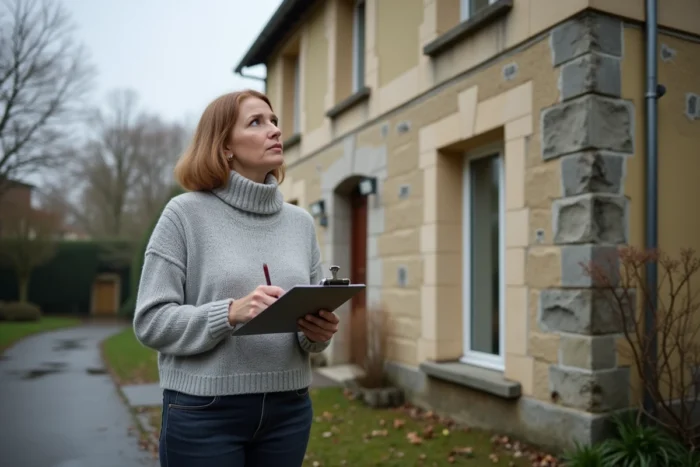
Thermal insulation obligation during renovation: the regulatory framework in 2026
Since the law on energy transition, a renovation covering more than half of the facade surface triggers a thermal insulation obligation. This point radically changes the budget and planning of a post-winter repair.
In co-ownership, the situation becomes stricter. Co-ownerships with a building permit prior to 2013 must have a mandatory collective energy performance diagnosis (DPE), and those over fifteen years old must establish a ten-year multi-year work plan (PPT). Therefore, facade repairs after a rainy winter can no longer be decided solely based on a visual assessment: they must align with the PPT and the energy renovation priorities defined by the collective DPE.
The mandatory work fund in co-ownership can finance facade interventions related to winter damage, provided the property manager has properly budgeted for these items. Anticipating the regulatory aspect prevents the need to initiate a second insulation project a few months after a simple renovation.
Facade treatment after winter: prioritizing interventions
Acting quickly does not mean acting chaotically. The treatment sequence follows a precise logic that determines the durability of each intervention.
- First, resolve the causes of infiltration: gutters, rainwater downspouts, failing joints, slope defects on supports.
- Next, allow the walls to dry. A wall saturated with water after winter requires several weeks of drying before any application of coating or paint. Applying a coating on a damp substrate traps water and causes blisters or rapid detachment.
- Finally, treat the stabilized cracks, then apply the finishing coat suitable for the type of substrate and the exposure of the facade.
Skipping a step compromises the whole process. We find that the majority of renovation failures stem from treatments applied to a substrate still loaded with moisture or on unstabilized cracks.
The choice of repair material also depends on the nature of the wall. A cement coating on an old limestone wall prevents the migration of water vapor and concentrates moisture in the masonry. A lime coating remains the suitable treatment for old buildings, even if its implementation takes more time.
Scheduling a methodical inspection as soon as winter ends, placing witnesses on suspicious cracks, and adhering to the cause-drying-repair sequence allows for budget control and avoids rework. The regulatory framework of 2026 adds an additional constraint in co-ownership, but it also encourages comprehensive facade treatment rather than successive patches.