
Regular exposure to a natural environment affects specific biological markers: cortisol, heart rate variability, inflammation, directed attention capacity. Syntheses published in 2026, notably by the EuroPARC Federation, now treat nature as a public health infrastructure, on par with a hospital network or a sanitation system. This change in status alters how everyone can think about their daily relationship with the living world.
Biological mechanisms of exposure to nature
Popular content often speaks of “anti-stress benefits” without going further. Recent studies, however, detail distinct physiological pathways. The effect is not limited to a subjective feeling of calm.
Trials reported in syntheses from 2026 measured changes in heart rate variability after stays in vegetated environments. This parameter, controlled by the autonomic nervous system, reflects the body’s ability to adapt to stress. Higher variability is associated with better recovery and lower cardiovascular risk.
Salivary cortisol, a hormonal marker of stress, decreases with repeated exposure to green spaces. Systemic inflammation, measured by certain blood biomarkers, follows a similar trend. These results shift the discussion: nature is not a comfort supplement; it is a prevention lever.
Directed attention, which allows one to focus on a task while filtering distractions, is restored more quickly in a natural setting than in a dense urban environment. This phenomenon, documented since the 1990s under the name of attention restoration theory, finds confirmation in recent data with more rigorous protocols.
Resources like faites-de-la-nature.fr help identify nature events and outings organized throughout France, facilitating a first regular contact with these environments.
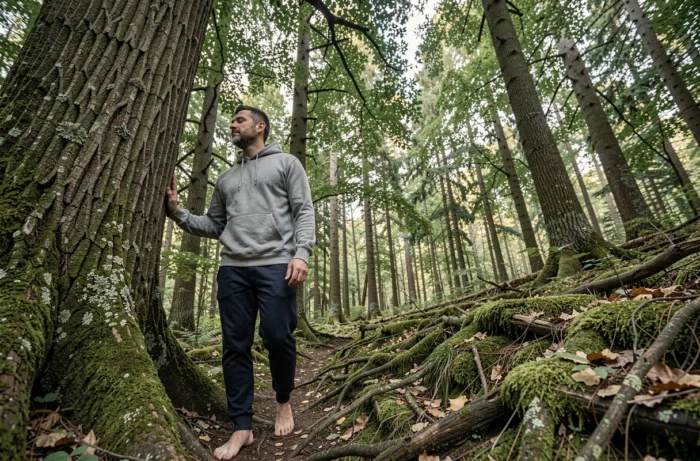
Minimum effective dose: how much time in nature per week
The question of the necessary duration arises consistently. The Health from Nature program of the Finnish Institute for Health and Welfare (THL), updated in August 2026, provides a clear answer: measurable benefits appear after ten to fifteen minutes of nature.
This low threshold changes the game for people living in urban areas. There is no need to plan a three-hour hike in the forest every weekend. Short visits, repeated a few days a week, are sufficient to trigger the mechanisms described above.
Repetition matters more than the unitary duration. Three fifteen-minute outings in an urban park produce a more pronounced cumulative effect than a single long outing followed by six days without exposure. This principle of regularity also applies to passive forms of exposure: opening a window to a treed area, eating near a garden, walking on a tree-lined street rather than a concrete one.
Micro-exposures in urban contexts
The effect of nature exists even on a very small scale. Research reported in 2026 shows that the mere presence of vegetation visible from a window influences perceived stress levels and certain physiological parameters.
Specifically, three levers are accessible without changing homes:
- Placing live plants in the rooms where one spends the most time, favoring species with dense foliage that alter the perceptual quality of the space.
- Consistently choosing a walking or cycling route that passes through a green space, even if this route is slightly longer than the most direct one.
- Taking work breaks in a public garden, a square, or a green courtyard, rather than in an enclosed indoor space.
These adjustments may seem anecdotal. Their cumulative effect over several weeks is not.

Nature and mental health: beyond relaxation
Reducing the nature-mental health link to relaxation would be incomplete. Recent data point to an effect on mental rumination, the cognitive process where thoughts loop around negative concerns.
Experimental protocols have compared walks in natural and urban environments. After a walk in nature, activity in brain areas associated with rumination decreases measurably. This result pertains to adults without diagnosed psychiatric disorders, giving it broad preventive implications.
The sound environment plays an underestimated role. Natural sounds (flowing water, wind in the leaves, birdsong) activate the parasympathetic nervous system, which manages recovery. Urban sounds (traffic, air conditioning, digital alerts) instead maintain a prolonged state of alertness that promotes cognitive exhaustion.
Nature prescription: a clinical trend
Several countries are now experimenting with prescribing time in nature by doctors. The concept goes beyond simple hygiene-dietary advice: it involves formal prescriptions directing individuals to parks, forests, or coastal areas, sometimes with follow-up.
This approach is based on a pragmatic observation. For certain mild forms of anxiety or depression, regular exposure to nature produces effects comparable to other non-drug interventions, with almost no cost and no side effects.
Green spaces and sustainable daily planning
The synthesis published by the EuroPARC Federation in August 2026 qualifies nature as an important infrastructure for health. This formulation has concrete implications for urban planning and individual choices.
On a personal scale, this means that the criterion “proximity to a green space” deserves as much attention as proximity to transport or shops when choosing housing. Available data show that the distance to the nearest green space is correlated with several indicators of mental and physical health in urban populations.
On a collective scale, municipalities that invest in greening, creating ecological corridors, or preserving local biodiversity are not just improving the environment: they are engaging in health prevention. This dual benefit, ecological and health-related, justifies increased attention to nearby natural spaces.
The most protective lifestyle is not one that accumulates large expeditions in nature, but one that maintains frequent, even brief, contact with the living world. Fifteen minutes in a park, an open window onto trees, a modified route to follow a river: these micro-decisions, repeated, constitute an accessible and free form of prevention.