
A letter supposedly sent by the Dirección General de Tráfico (DGT) arrives at your French home. Before settling anything, the first step is to verify the authenticity of the document. Phishing campaigns targeting foreign drivers are multiplying, and fake fine notices now reproduce logos, headers, and case references with deceptive realism.
Official DGT Notification Channels for Foreign Drivers
The DGT never notifies a fine by email or SMS. Any sanction addressed to a foreign driver is sent through two exclusive channels: certified postal mail, sent to the address registered at the time of the offense, or the Dirección Electrónica Vial (DEV) if the vehicle owner has voluntarily registered.
The DEV has been mandatory for legal entities since November 2022, but it remains optional for individuals. A French driver passing through Spain who has never registered for the DEV will therefore not receive an official electronic notification. If an email mentions a payment link or an attachment, it is a fraud attempt.
We recommend verifying any suspicious notification directly via the DGT’s sede electrónica or the miDGT app, and never by clicking on a link received via messaging. This is the only reliable way to confirm the actual existence of an infringement case related to your license plate number.
A detailed guide on DGT fines in Spain in French specifies the visual and textual elements to check on each document received.
Anatomy of an Authentic DGT Postal Letter: Mentions and Structure
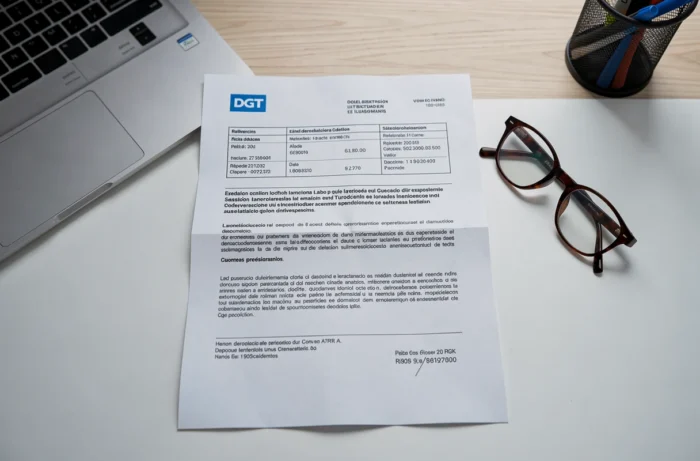
A fine notice issued by the DGT follows strict administrative formalities. Several mentions allow distinguishing an official document from a counterfeit.
- The case number (expediente) appears at the top of the letter. This number can be verified on the DGT’s sede electrónica by also entering the date of the offense and the total amount.
- The header includes the mention “Ministerio del Interior – Dirección General de Tráfico” accompanied by the official emblem of the Spanish state, not just a simple graphic logo.
- The letter mentions the vehicle identification (license plate), the exact location of the offense, the date and time, as well as the legal basis for the sanction (article of the Spanish traffic code).
- The mention of the reduced payment deadline is explicitly included: the driver has twenty days to benefit from a reduction on the initial amount.
- The return address corresponds to an identifiable provincial traffic office, not an anonymous PO box or a generic domain.
A fake letter often reproduces the logo but omits the specific legal basis or uses a case number that does not correspond to anything on the official portal. The absence of a verifiable expediente number is the most reliable warning signal.
Difference Between DGT Notification and Cross-Border Recovery via the European Directive
The most frequent confusion among French drivers concerns the origin of the letter. An offense committed in Spain can generate two distinct types of correspondence, and neither resembles a classic French fine notice.
The first case is direct notification by the DGT, in Spanish, addressed to the holder of the registration certificate via data transmitted by the European vehicle file. This letter usually arrives within weeks following the offense.
The second case occurs when the fine remains unpaid. Spain can then resort to cross-border cooperation to enforce the sanction. The driver then receives a letter from the Spanish Treasury or a mandated recovery agency, sometimes partially translated into French. A recovery letter does not replace the initial notification: if you have never received the original notice, the procedure can be contested.
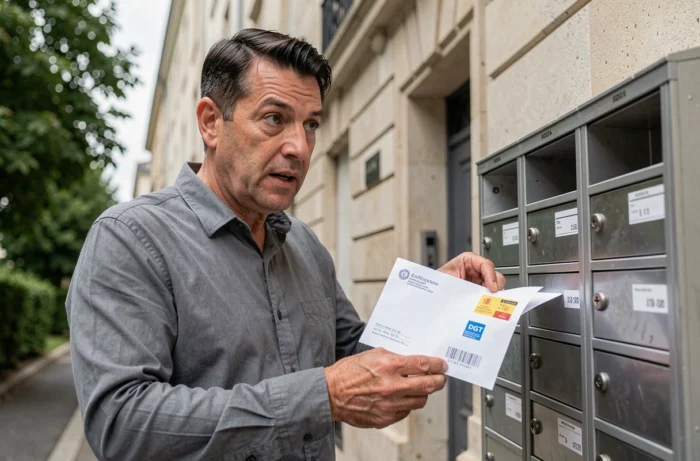
We observe that some drivers confuse these recovery letters with scams, precisely because they arrive several months after the stay in Spain and do not resemble anything familiar in the French system. Verification via the sede electrónica remains the reference method to dispel doubts.
DGT Phishing: Concrete Signals to Detect a Fake Letter or Message
Fraud attempts impersonating the DGT particularly target foreign drivers, who are less familiar with the Spanish procedure. Several technical clues allow dismissing a fake document without particular expertise.
- A message received by email or SMS mentioning the DGT is fraudulent by default, as the DGT does not use these channels to notify sanctions.
- A payment link pointing to a domain other than sede.dgt.gob.es indicates a phishing page. Fake sites use similar variants (dgt-es.com, multas-dgt.es) that do not belong to the Spanish administration.
- A paper letter requesting payment via a transfer to a non-Spanish IBAN, or through an online payment platform not linked to the sede electrónica, is a counterfeit.
- The absence of mention of the NIE or the complete vehicle registration number in the body of the document is an additional indicator of fraud.
Any legitimate DGT fine can be checked on the sede electrónica by entering the case number, date, and amount. If these three data points return no results, the document is fraudulent.
Online Verification on the DGT Sede Electrónica Without a Digital Certificate
The DGT offers a consultation and payment procedure accessible without a Spanish digital certificate or electronic identity card. You only need the case number, the date of the offense, and the amount stated in the received letter.
On the sede electrónica portal, the section dedicated to paying fines without a certificate allows verifying the existence of the case. The system requires that cookies be enabled in the browser and works on common browsers, including mobile.
If the entered data does not match any active case, two hypotheses arise: either the letter is fraudulent, or the notification period has not yet expired. In the latter case, we recommend retrying the verification a few days later before concluding a scam.
A French driver receiving a letter from the DGT does not need to have a NIE to perform this verification. The expediente number alone, combined with the other two data points, is sufficient to authenticate the sanction and, if applicable, to proceed with online payment by credit card.