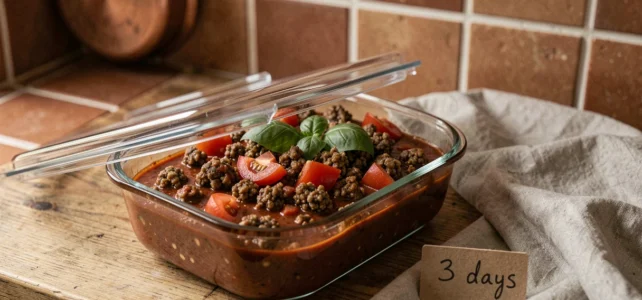
On Sundays, we prepare a big pot of bolognese sauce, eat it in the evening, and then store the rest in the fridge, telling ourselves we’ll finish it during the week. Three days later, the sauce still looks good, and the smell remains normal. The temptation to reheat it is strong, but cooked ground meat is one of the most sensitive ingredients microbiologically, even when drowned in tomatoes and herbs.
The shelf life of homemade bolognese sauce depends on several concrete factors, starting with what happens between the end of cooking and the moment the dish reaches the cold of the refrigerator.
The danger zone, the first risk factor for homemade bolognese
Most food safety incidents related to leftovers do not occur on the third or fourth day in the fridge. They begin much earlier, during cooling.
Between 5 °C and 60 °C, bacteria multiply at a considerable rate. A bolognese sauce left to cool on the stove for three or four hours accumulates a bacterial load that the cold will only slow down, not eliminate. Current recommendations set a maximum time of two hours between cooking and refrigeration. If the room is very hot (summer, poorly ventilated kitchen), this time drops to one hour.
In practice, we don’t wait for the entire pot to cool down at once. We distribute the sauce into several shallow containers to speed up the temperature drop. A tall, narrow container filled to the brim takes much longer to drop below 5 °C than a flat tray that is half full.
Bolognese sauce in the refrigerator: why the limit is two to three days
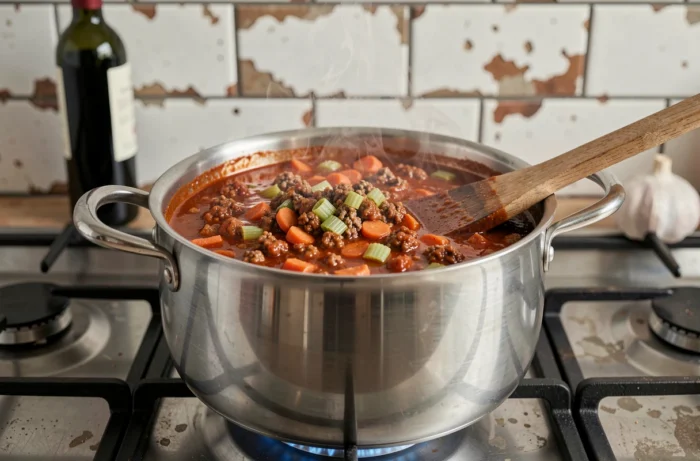
Cooked ground meat remains a risky product even after complete cooking. Its fragmented structure offers a much larger surface area for microorganisms to thrive compared to a whole piece. Recommendations converge on two to three days in the refrigerator at a maximum of 4 °C for a homemade dish containing ground meat.
This is shorter than what is often read on forums, where some mention five or even seven days. Salt and the acidity of tomatoes do indeed slow down bacterial proliferation, but they do not sterilize the sauce. A bolognese is not a confit or a vacuum-sealed preserve.
Factors that further shorten the duration
- A refrigerator set above 4 °C (many household fridges hover around 6-7 °C without us knowing, due to the lack of an internal thermometer)
- Frequent openings of the container, or using a spoon that has already been in the mouth to serve more
- An initial cooling time that is too long, which has already compromised safety before refrigeration
- The presence of very hydrated vegetables (zucchini, mushrooms) that increase the water activity in the sauce
When planning not to finish the sauce within two days, it is better to freeze the excess portion on the day of preparation rather than leaving it in the fridge for three days before deciding.
Freezing bolognese sauce: duration and concrete method
In the freezer, homemade bolognese sauce can be stored for two to three months under good conditions. Beyond that, the sauce remains technically consumable, but the texture degrades (the fat can become grainy, and the tomatoes mealy).
The most effective method is to portion the sauce before freezing. Fill airtight containers or freezer bags, leaving a little space for expansion. If freezing pasta with the sauce, the pasta noticeably softens after thawing. Keeping them separate yields a much better result when reheating.
Safe thawing and reheating
Thawing in the refrigerator, slow but safe, remains the recommended method. Take the portion out the night before. Transferring directly from the freezer to the pot also works, provided to heat on low while stirring frequently to avoid the center staying cold.
When reheating, the sauce must reach a sufficient core temperature to eliminate any bacteria that may have developed. A vigorous simmer for a few minutes is enough. However, reheating the same portion multiple times increases the time spent in the danger zone, making each cycle a bit riskier than the last.
Signs of spoilage in bolognese sauce: what to rely on
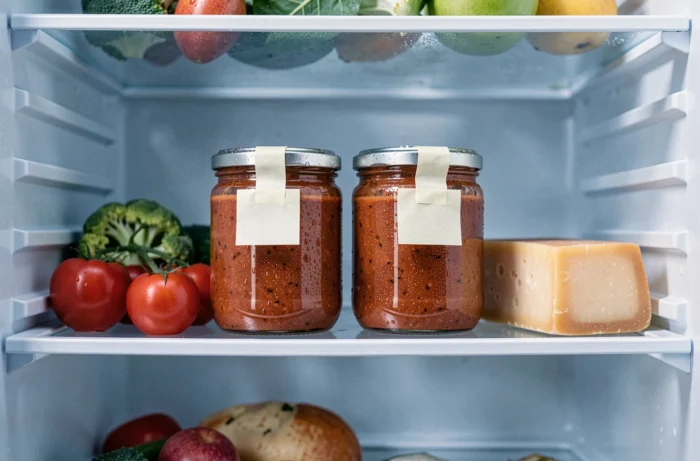
The smell remains the first reliable indicator. A sauce that turns sour or fermented has spoiled, even if its color seems normal. A pronounced browning of the surface, visible mold, or an unusual sour taste are clear signals.
Opinions vary on this point, but the absence of visible signs guarantees nothing. Some pathogenic bacteria do not alter the appearance or smell of food. This is precisely why the two to three days rule in the fridge exists: it sets a time limit independent of appearance.
For vulnerable individuals (young children, pregnant women, the elderly, or immunocompromised individuals), caution dictates adhering to the lower limit of two days without attempting to visually assess the sauce.
A well-managed bolognese sauce is one that is portioned quickly after cooking, refrigerated within two hours, and consumed within two to three days, or frozen on the first evening. All safety hinges on those first hours after cooking, much more than in the following days in the fridge.