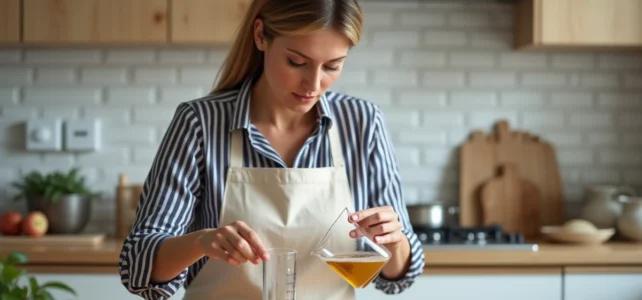
In cooking, 60 milliliters is equivalent to 6 centiliters. This conversion is based on a unique rule of the metric system: divide the value in milliliters by 10. The calculation seems simple, but dosage errors with liquids remain common, especially when a recipe mixes units or when the measuring cup has poorly readable graduations.
Why the factor of 10 between milliliters and centiliters simplifies everything
The prefix “milli” denotes a thousandth, while the prefix “centi” denotes a hundredth. Therefore, one liter contains 1,000 milliliters and 100 centiliters. The ratio between these two sub-units is always 10 to 1.
The formula can be summarized in one operation: cl = ml ÷ 10. To convert 60 milliliters to centiliters, you divide 60 by 10 and get 6 cl. The reverse works by multiplication: 6 cl × 10 = 60 ml.
This symmetry makes the conversion purely mental. No need for a chart or calculator. You just need to move the decimal point one place to the left (ml to cl) or to the right (cl to ml).
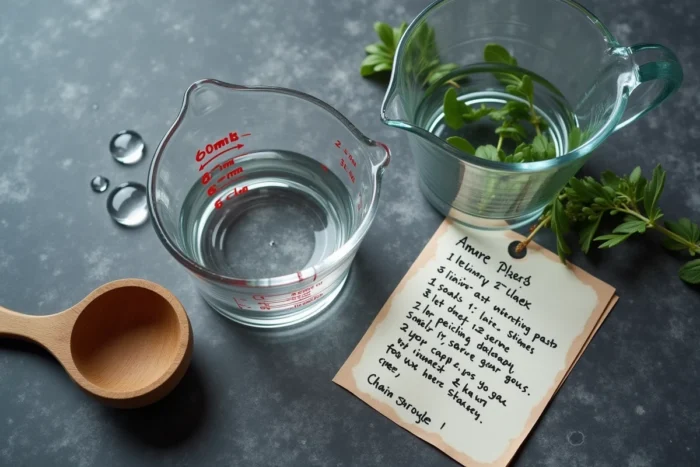
Conversion ml to cl: the decimal point trap in recipes
When a recipe indicates 60 ml of liquid cream, converting to 6 cl poses no difficulty. The problem arises with less round values. 125 ml of milk becomes 12.5 cl. 15 ml of olive oil corresponds to 1.5 cl.
The shifted decimal point remains the only operation to remember. Any other manipulation (dividing by 100, multiplying by 0.01) introduces a risk of unnecessary error.
A classic case of confusion: Anglo-Saxon recipes converted into French. Some indicate volumes in milliliters while common utensils in France (measuring cups, caps, jars) display centiliters. A quick reading can confuse 15 cl and 15 ml, resulting in a 1 to 10 ratio on the poured quantity. In a sauce or syrup, this error radically changes the outcome.
Measuring 6 cl without a measuring cup: equivalents with common utensils
Not all cooks have a graduated measuring cup. Knowing the standard volumes of everyday utensils allows for dosing 60 ml (thus 6 cl) with acceptable precision.
- A tablespoon holds about 15 ml. Four heaping tablespoons give 60 ml.
- A teaspoon holds about 5 ml. Therefore, you need 12 to reach 60 ml, which is not very practical but useful for very small adjustments.
- A standard coffee cup holds about 10 cl (100 ml). Filling this cup a little above halfway gives an approximation of 6 cl.
These equivalents work well for water, milk, broth, or any preparation with a density close to water. For thicker liquids (honey, maple syrup, heavy cream), the spoon tends to retain more material, slightly skewing the actual volume.
The precision scale as an alternative to the measuring cup
For pure water, 60 ml weighs exactly 60 grams. This equivalence volume = weight only holds for liquids whose density is close to 1. Whole milk comes close. Oil, being lighter, weighs less than its volume in milliliters.
Weighing a liquid on a kitchen scale often offers more precision than reading it on a measuring cup, especially when the graduations are spaced 50 ml apart. On a scale displaying grams, the maximum deviation remains minimal.
Common recipes that use 60 ml as a measurement
The volume of 60 ml regularly appears in pastry and sauce recipes. A vinaigrette for four people often calls for 6 cl of oil. Some pancake batters include 60 ml of melted butter. Asian marinades frequently measure soy sauce or rice vinegar in multiples of 15 ml, and 60 ml (four tablespoons) is a common base for four servings.
Adapting the proportions of a recipe involves multiplying or dividing this base factor. For two people instead of four, 60 ml becomes 30 ml, or 3 cl. For six people, it goes to 90 ml (9 cl). The calculation remains mental as long as you keep the reflex of dividing by 10 to revert to centiliters.
Applications and digital tools to avoid conversion errors
Common content on ml/cl conversion is limited to printed charts and mental calculations. However, modern recipe applications offer a more effective function: automatic recalculation of measurements when the number of servings is modified.
By entering the desired number of guests, the app adjusts all volumes (and weights) accordingly. No need to manually convert 60 ml to 6 cl, then multiply by 1.5 to go from four to six people. The tool directly displays 9 cl or 90 ml depending on the chosen unit.
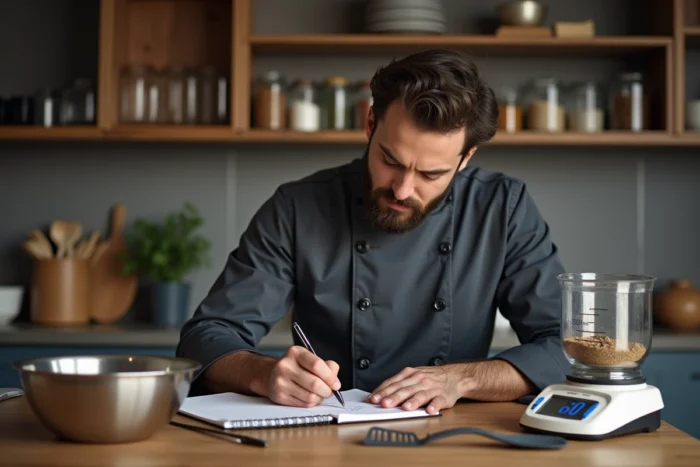
Combining this type of application with a precision scale significantly reduces approximations. The measuring cup remains useful for large volumes (half a liter of broth, for example), but for quantities under 100 ml, the scale and digital calculator offer better control.
Summary table: most used ml to cl conversions in cooking
| Milliliters (ml) | Centiliters (cl) | Utensil equivalence |
|---|---|---|
| 5 ml | 0.5 cl | 1 teaspoon |
| 15 ml | 1.5 cl | 1 tablespoon |
| 30 ml | 3 cl | 2 tablespoons |
| 60 ml | 6 cl | 4 tablespoons |
| 100 ml | 10 cl | 1 coffee cup |
| 200 ml | 20 cl | 1 mustard glass |
| 250 ml | 25 cl | 1/4 liter |
| 500 ml | 50 cl | 1/2 liter |
The conversion between milliliters and centiliters only requires one operation, division by 10. Remembering that 60 ml equals 6 cl is sufficient for most everyday recipes. For precise measurements in baking or sauces, a scale displaying grams effectively complements the measuring cup, especially for small volumes where the graduations lack finesse.