
An insect spotted on a damaged leaf does not necessarily mean it is the culprit. The larva resting there may be a predator that came to feed on the real pest, which has already left. Distinguishing harmful insects from beneficial ones in your garden requires observing more than just appearance: the damage to the plant, the insect’s stage of development, and its actual behavior.
Read the damage before identifying the insect on your plants
Have you noticed sticky, curled, or shiny substance-covered leaves? This honeydew is a characteristic sign of the presence of aphids or scale insects. Conversely, clean holes in the leaves point more towards caterpillars or flea beetles.
Visible damage is a more reliable clue than the insect itself. A gardener who spots fine webs under the leaves will suspect mites. Accumulated white skins indicate a colony of whiteflies. Observing the traces before searching for the culprit helps avoid confusing a beneficial insect with a pest.
Larvae pose a particular problem. An elongated, gray-brown larva found at the base of a lettuce plant could be a crane fly larva (harmful, which gnaws at the roots) or a ground beetle larva (beneficial, which hunts slugs and snails). The difference between the two, as read on La Fibre Câline, often lies in the context: where is it located, what is it doing, is the plant actually under attack?
A yellow or blue sticky trap placed near crops helps detect discreet pests like thrips early on. This simple method provides a more accurate picture of the insect population present than observation with the naked eye.
Garden auxiliaries: three distinct roles to know
Not all beneficial insects do the same job. Grouping them under the label “good insects” prevents understanding why each one matters.
Predators that regulate pests
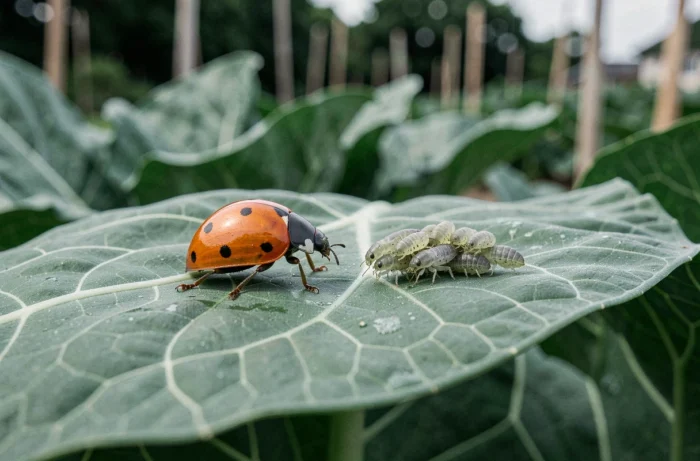
The adult ladybug and its larva consume significant amounts of aphids. The green lacewing, often overlooked, is formidable in its larval stage: it preys on aphids, thrips, and the eggs of various pests. The tiny orange larvae of gall midges do similar work.
A predatory auxiliary acts on several pest species at once. This makes it more effective than a treatment targeting a single parasite.
Parasitoids, discreet regulators
Parasitoid wasps lay their eggs directly inside the bodies of aphids or caterpillars. The host dies, and a new wasp emerges. These insects are so small that they are rarely noticed, but their effect on pest populations is considerable.
Do you spot swollen, golden, or frozen aphids on a stem? These are “mummies”: parasitized aphids. A mummified aphid is a sign that parasitoids are already working in your garden.
Pollinators
Bees, bumblebees, hoverflies, and butterflies ensure the fertilization of flowers, thus the production of fruits and seeds. Without them, a vegetable garden of tomatoes, zucchinis, or strawberries produces little or nothing at all.
The hoverfly deserves special attention: the adult pollinates flowers, and its larva devours aphids. The hoverfly combines the roles of pollinator and predator.
Regulatory framework: what amateur gardeners can use
Since January 1, 2019, individuals can only use biocontrol products or those labeled “authorized for use in gardens.” Conventional synthetic pesticides are prohibited for purchase, possession, and use by non-professional gardeners.
This constraint changes the game. A treatment applied without prior identification of the pest risks eliminating beneficial insects without solving the problem. Worse, it may fall outside the legal framework for use.
Correctly identifying the insect before taking action is therefore not just good gardening practice: it is also a practical obligation related to regulations.
Observation method to distinguish harmful and beneficial insects in the garden
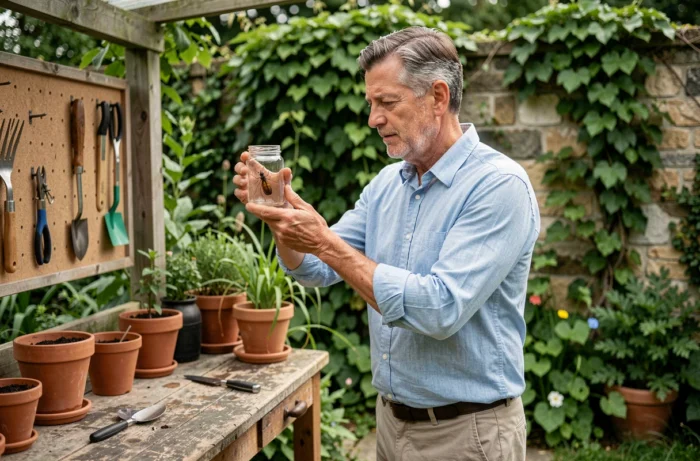
Rather than a catalog of species, here is an analysis grid applicable to each situation.
- Examine the plant first: deformed leaves, honeydew, galleries in the stems, holes in the fruits. If no damage is visible, the insect present is likely neutral or beneficial.
- Observe the insect’s behavior: a predator moves actively and captures other insects. A pest remains in a colony, often motionless, on the underside of the leaves.
- Consider the stage of development: many beneficial insects are unrecognizable in their larval stage. The ladybug larva, black and elongated with orange spots, looks nothing like the adult red with black spots.
- Use a pocket magnifying glass for insects smaller than two millimeters. Thrips, mites, and young aphids are often invisible without magnification.
An insect found on a healthy plant is almost never a pest. Beneficial insects patrol where their prey lives, and their presence indicates a balanced ecosystem.
Promote biodiversity rather than sorting species
Seeking to eliminate every insect identified as harmful simplifies a system that functions through interactions. A garden where aphids are present in small numbers attracts ladybugs, lacewings, and hoverflies, which naturally regulate the population.
Planting a variety of flowers (phacelia, yarrow, fennel, cosmos) provides nectar and pollen to adult beneficial insects. A flowering bed near the vegetable garden reduces pest pressure without chemical intervention. Leaving a corner of the garden uncut offers winter refuge for ground beetles and lacewings.
The distinction between harmful and beneficial is not a fixed list. The same insect may be considered annoying in one crop and harmless in another. The earwig sometimes gnaws on dahlia petals, but it also consumes aphids and psyllids. It all depends on the context, population density, and what you are growing.
The most effective reflex remains regular observation, two or three times a week in season. A gardener who knows the normal state of their plants quickly spots an anomaly and can intervene in a targeted way before the problem settles in.