
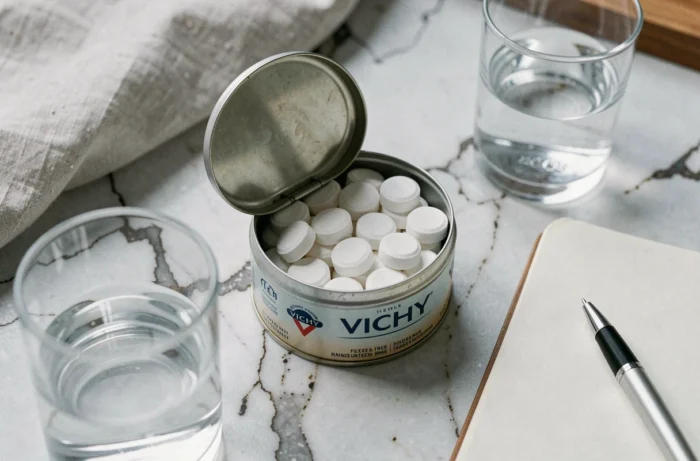
We chew two or three Vichy pastilles after a hearty meal, reflexively, without really questioning what we are swallowing. The sodium bicarbonate they contain temporarily relieves gastric acidity, but this image of a “digestive” candy masks concrete limits. For some people, regular or excessive consumption poses real problems, from excess sodium to digestive issues caused by sweeteners.
Sugar-free Vichy pastilles and polyols: the digestive trap that no one mentions
The classic versions of Vichy pastilles contain sugar. The sugar-free versions replace this sugar with sweeteners and polyols. We think we are making a healthier choice, but the effect on the digestive tract can be the opposite of what is intended.
Polyols (sorbitol, maltitol, xylitol, and others) are sugar alcohols poorly absorbed by the small intestine. When consumed beyond a certain threshold, they ferment in the colon. The result: bloating, flatulence, abdominal cramps, and sometimes diarrhea. This threshold varies from person to person, but a few pastilles are enough for sensitive individuals.
To fully understand the side effects of Vichy pastilles, we must distinguish between the sugary version and the sugar-free version: the risks are not the same. The classic version mainly poses a sodium and calorie issue. The sugar-free version adds this digestive component related to sweeteners, which manufacturers note in small print on the packaging (“excessive consumption may have laxative effects”).
Sugar-free pastilles are not a neutral choice for the intestine. For people suffering from irritable bowel syndrome, polyols are among the FODMAPs to avoid. Taking these pastilles “to aid digestion” can then worsen the problem one intended to solve.

Sodium in Vichy pastilles: who should really be cautious
Sodium bicarbonate is the active ingredient that gives Vichy pastilles their digestive reputation. It neutralizes stomach hydrochloric acid, temporarily relieving heartburn and acid reflux. The problem is that “sodium” and “sodium bicarbonate” mean a salt intake that many consumers underestimate.
Each pastille contains a modest amount of sodium when taken in isolation. But we rarely eat just one pastille. And, more importantly, this intake adds up to everything we consume throughout the day: bread, cheese, cold cuts, prepared meals. For a healthy adult, a few occasional pastilles do not change the overall balance.
At-risk profiles regarding the sodium in pastilles
The situation changes radically for three categories of people:
- People with hypertension or on a low-sodium diet must drastically limit their daily sodium intake. A few pastilles a day represent a significant addition to an already tight count.
- People suffering from kidney insufficiency have a reduced ability to eliminate excess sodium, which can worsen water retention and edema.
- Pregnant women, for whom excess sodium promotes water retention and can complicate already existing gestational hypertension.
For these profiles, Vichy pastilles are not an innocuous candy. We are talking about a product that combines sodium intake with an alkalizing effect, two parameters that these individuals must monitor closely.
Occasional use after a heavy meal or daily snacking: the distinction that matters
The “digestive” reputation of Vichy pastilles comes from a specific use: one or two are taken after a rich meal to calm a feeling of heaviness or acidity. In this occasional context, bicarbonate acts as a mild and temporary antacid, and most adults tolerate it without issue.
The shift occurs when pastilles become an office candy, a systematic post-meal reflex, a daily habit. We move from contextual use to regular snacking, and the quantities increase without us paying attention.
What repetition changes
A daily and repeated intake of sodium bicarbonate can alter the acid-base balance of the stomach. The body compensates by producing more gastric acid, known as rebound effect. We then end up with more acidity than at the start, prompting the need to take more pastilles. The cycle is established.
Reserving Vichy pastilles for occasional and specific use remains the only reasonable approach. They do not replace a prescribed antacid or a change in dietary habits when heartburn occurs frequently.
Warning signals: when to reduce or stop Vichy pastilles
We tend to think that a candy sold in supermarkets cannot really pose a problem. Vichy pastilles are not dangerous in themselves, but they can trigger signals that the body clearly sends.
- Persistent bloating or gas after each intake, especially with sugar-free versions, indicates an intolerance to polyols.
- A burning sensation in the stomach that returns stronger after the effect of the pastilles signals a possible acid rebound effect.
- Transit issues (loose stools, diarrhea) that coincide with regular consumption should raise alarms.
- Swelling in the ankles or rapid weight gain in someone monitoring their blood pressure may be related to sodium retention.
In each of these cases, the course of action is simple: stop taking the pastilles for a few days and observe. If the symptoms disappear, the cause is identified. If they persist, medical advice is necessary, as the problem likely lies elsewhere.
Vichy pastilles remain a pleasant and generally well-tolerated candy when consumed infrequently, in small quantities, and without accumulating risk factors. The real danger is not the pastille itself, but the daily habit and lack of vigilance among those who should monitor their sodium intake or avoid polyols.