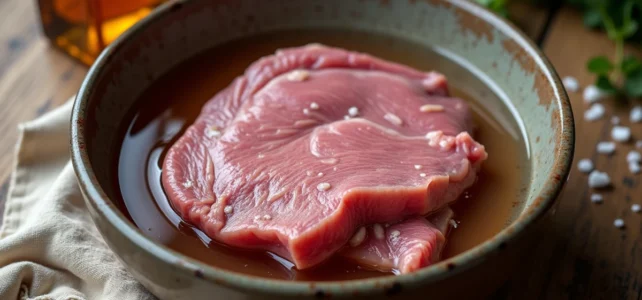
The vinegar purging of beef tongue is one of those gestures passed down without question, repeated from one generation to the next as an absolute prerequisite. The technical reality is more nuanced: this step is not mandatory, and its usefulness depends on specific parameters that we will detail.
Vinegar and offal: the real chemical mechanism on beef tongue
White vinegar, in solution in cold water, acts primarily as a odor neutralizing agent. The acetic acid it contains modifies the surface pH of the piece, which limits the volatility of certain sulfur compounds responsible for the strong odors characteristic of beef offal. This mechanism is documented for beef kidneys, where a bath of very cold water mixed with white vinegar serves to neutralize these odors before cooking.
On the tongue, the principle is the same. The thick mucosa covering the piece retains residual blood and secretions. Vinegar facilitates the expulsion of this blood through acid osmosis, hence the pink water observed after soaking. But contrary to popular belief, vinegar does not alter the final texture of the tongue. It does not tenderize the deep muscle fibers, which will only be transformed by long cooking at moderate temperatures.
We recommend clearly distinguishing between two often-confused objectives: removing residual blood (purging) and sanitizing the surface (disinfection). Vinegar contributes to both, but neither is irreplaceable by other methods. The pertinent question before purging beef tongue with vinegar is that of the freshness and origin of the piece.
Blanching versus vinegar soaking: which method to choose for the tongue
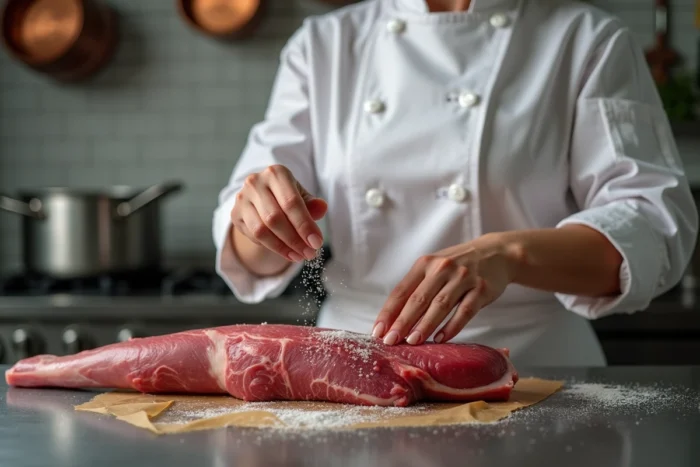
The current trend in professional cooking favors blanching over vinegar purging for preparing beef tongue. The protocol is straightforward: thorough rinsing in cold water, followed by immersion in a pot of cold water brought to a boil. The simmering is maintained for a few minutes, this first water laden with impurities is discarded, and then rinsed again before starting the main cooking in a flavored broth.
Blanching removes more impurities than static soaking. The rise in temperature causes the coagulation of blood proteins on the surface, which forms the well-known grayish foam. This foam, removed with the first water, takes with it a large part of the compounds responsible for odors and the metallic taste.
The vinegar soaking, on the other hand, works cold and over a long duration (often an entire night). It is more suitable in two specific cases:
- The tongue comes from a long supply chain, with a significant delay between slaughter and purchase, and exhibits a marked odor upon unwrapping.
- The piece has been frozen without prior purging, which concentrates blood residues in the tissues after thawing.
- The cook desires a very mild taste, particularly for cold preparations in jelly or salad, where the metallic notes are more pronounced.
For a fresh tongue purchased from a trusted butcher, a simple rinse followed by blanching is sufficient. We observe that this approach aligns with practices for other offals like sweetbreads: a very fresh product requires only rinsing and thorough drying, with prolonged purging becoming optional.
Cooking beef tongue: the true factor of tenderness
No soaking can replace properly conducted cooking. The tongue is a dense muscle, rich in collagen, which requires a long cooking time for this collagen to transform into gelatin. It is this transformation, and only this, that produces the sought-after melting texture.
The classic method involves poaching the tongue in a flavored broth (onions studded with cloves, carrots, bouquet garni, whole pepper) at a steady simmer. The pressure cooker significantly reduces this time, but the principle remains the same: moist and prolonged cooking at controlled temperature.
The reliable cooking test remains the tip of a knife inserted into the thickest part. If it penetrates without resistance, the tongue is ready. Peeling the skin is done immediately after cooking, while the piece is still hot: the mucosa then easily detaches in large strips. If you wait for it to cool completely, the operation becomes laborious.
Poaching broth and Madeira sauce
The poaching broth concentrates the flavors extracted during cooking. It serves as a remarkable sauce base, particularly for the classic Madeira sauce that traditionally accompanies this dish. The broth is filtered, reduced, and then Madeira is added at the end of the sauce cooking to preserve its aromas. The tangy sauce with pickles represents another classic, built on the same poaching base.
Keeping the broth rather than discarding it is a professional reflex. It freezes perfectly and serves as a base for other meat or braised veal preparations.
Beef tongue: when vinegar remains relevant and when to skip it
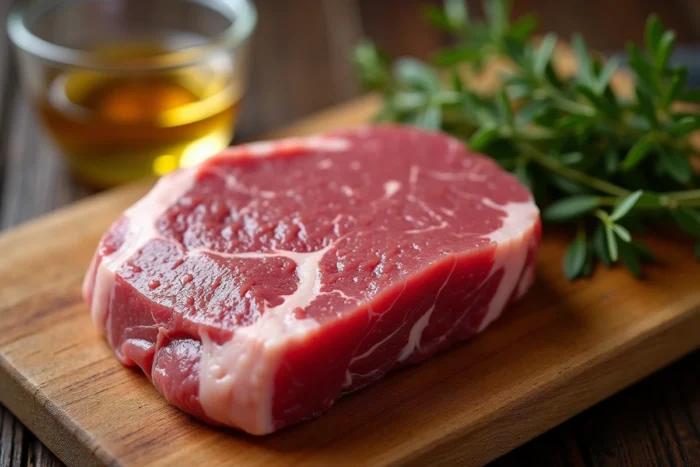
Vinegar purging is not an unnecessary step. It has its place in a preparation protocol, provided one knows why it is done. Here are the concrete decision criteria:
- Fresh tongue of the day, purchased from an artisan butcher: rinsing + blanching. Vinegar will not provide any measurable benefit.
- Supermarket tongue with a packaging date of several days: soaking in vinegar water for a few hours reduces the odor and improves the final taste.
- Frozen tongue without prior preparation: slow thawing in the refrigerator in vinegar water, which combines purging and thawing in one step.
- Cold recipe (tongue in vinaigrette, in jelly): vinegar purging is recommended, as residual blood notes are more perceptible at room temperature than when hot.
Vinegar remains a tool, not an obligation. Adapting it to the context of the piece and the recipe is a matter of culinary common sense, not an immutable rule. The freshness of the offal and the cooking method weigh much more heavily in the final result than the presence or absence of vinegar in the soaking water.