
A scooter that won’t start on a Monday morning at 7:45 transforms a well-established routine into logistical chaos. Most immobilizations are not due to heavy mechanical failures, but rather to progressive defects ignored for weeks: a tired battery, under-inflated tire, burnt-out bulb. Since the mandatory technical inspection for category L vehicles came into effect on April 15, 2024, the collected data confirms this reality.
Of the 2.21 million inspections carried out in 2024-2025, about 11.9% resulted in a re-inspection, mainly for issues related to wheels, tires, suspensions, lighting, and noise or pollution nuisances.
What the technical inspection reveals about everyday breakdowns
The reasons for re-inspection during the technical inspection of two-wheelers paint a precise picture of the most common negligence. It’s not seized engines or broken transmissions that dominate the statistics. The recurring defects concern elements that every owner can monitor without specific tools.
The most frequently recurring issues are tires, suspensions, and lighting. These are exactly the components that cause morning breakdowns or immobilizations on the roadside. A tire whose pressure gradually drops ultimately compromises road handling even before it goes flat. A suspension that clunks over every speed bump indicates a worn-out shock absorber, not just an innocuous noise.
Faulty lighting does not cause mechanical breakdowns, but a burnt-out position light can lead to a ticket during a roadside inspection, or even render the vehicle non-compliant. For a home-to-work trip taken early in the morning or late in the day, a faulty headlight becomes a real safety issue.
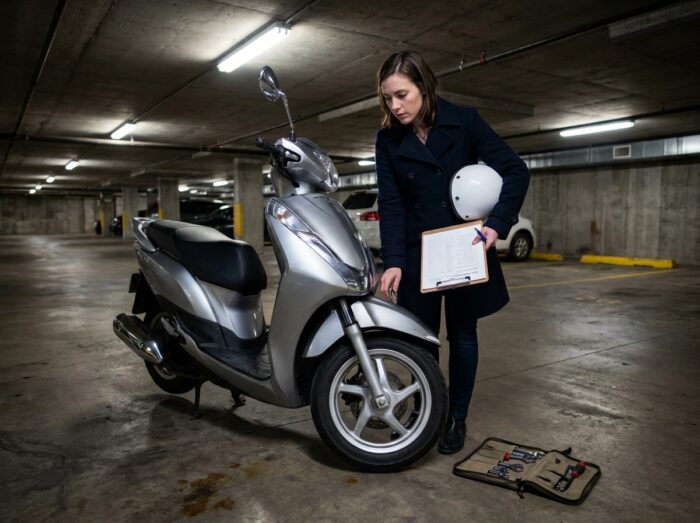
Weekly scooter check routine before a trip
A regular inspection does not need to last more than five minutes. The goal is to spot an emerging problem before it becomes a blocking issue. The best time for this check: Sunday evening or Monday morning, before the first use of the week.
The battery remains the number one weak point of scooters used daily. A difficult start, a warning light that dims upon contact, or a horn that sounds deeper than usual are signs of a battery nearing the end of its life. A simple voltage test with a multimeter is enough to anticipate replacement.
Properly maintaining your battery, in line with good motorcycle insurance against unpleasant surprises, starts with this regular vigilance.
Points to check each week:
- Tire pressure when cold, referring to the value indicated on the sidewall or in the manufacturer’s maintenance manual. An under-inflated tire increases consumption and degrades braking.
- Engine oil level (on thermal models) and visual condition of the coolant if the scooter is equipped with it. A trace on the ground under the parked vehicle deserves immediate investigation.
- Functionality of all lights: headlight, position light, brake light, turn signals. A quick test against a wall or reflective glass allows you to spot a faulty bulb without external help.
- Visual condition of the drive belt (when the cover is accessible): a cracked or worn belt can snap unexpectedly in heavy traffic.
Seasonal scooter maintenance: neglected components
Beyond the weekly routine, some components require attention on a longer timeline. The air filter, for example, gradually clogs in urban environments. A dirty filter reduces engine performance, increases consumption, and can cause acceleration hiccups. Its replacement, which is inexpensive, is often postponed due to forgetfulness.
Brake pads wear out without an audible signal on most scooters. Unlike cars equipped with wear indicators, a scooter does not always warn when braking becomes insufficient. Visually checking the thickness of the pads every two to three months prevents a critical situation.
The brake fluid absorbs moisture over time. Fluid that hasn’t been purged for several years loses effectiveness, especially in cold weather. Field reports vary on the ideal replacement frequency, but changing brake fluid every two years remains a good practice for daily use.
Scooter emergency kit: what fits in the under-seat storage
Even with rigorous maintenance, a one-off breakdown remains possible. The space under a scooter’s seat is limited, which necessitates selecting only the equipment that has real utility on the roadside.
- A puncture repair spray allows you to temporarily inflate a punctured tire and reach a garage. It does not replace a repair, but it prevents complete immobilization.
- A set of fuses corresponding to the scooter’s ratings. A blown fuse can cut off ignition, lights, or the starter, and can be replaced in seconds.
- A headlamp or small flashlight, useful for diagnosing a problem in the dark, especially in winter when trips are made before dawn.
A compact jump starter or portable battery booster can also find its place if the storage allows. These boosters, the size of a thick smartphone, provide enough current to restart a scooter whose battery has failed.

Service frequency and scooter maintenance log
Service intervals vary by manufacturer, but a scooter used daily for the home-to-work commute accumulates kilometers much faster than one used for leisure. A model averaging about twenty kilometers per day reaches the manufacturer’s maintenance deadlines in just a few months, not years.
Adhering to mileage intervals rather than calendar ones is the rule for intensive use. An oil change scheduled every certain thousands of kilometers comes around faster than you think when the scooter is ridden five days a week.
The maintenance log stamped by a professional also retains its value in case of resale. A well-maintained scooter with a documented history sells much better than an equivalent model without follow-up. This is a point rarely emphasized, but it matters when it’s time to change vehicles.
The mandatory technical inspection since 2024 adds an additional deadline to integrate into the maintenance calendar: the first inspection before the fifth anniversary of registration, then every three years. Anticipating this visit by maintaining the checked points (tires, brakes, lighting, emissions) avoids the re-inspection and the costs that accompany it.