
The Yamaha Xmax 125 leaves the dealership with an invisible restriction: that of the break-in period. During the first thousand kilometers, the engine operates below its true potential. The speed displayed on the speedometer then increases, sometimes surprisingly, before stabilizing around 10,000 km. Understanding this evolution helps avoid two common mistakes: pushing the engine too early or worrying about a disappointing top speed on a new scooter.
Speedometer or GPS: the true speed of the Xmax 125
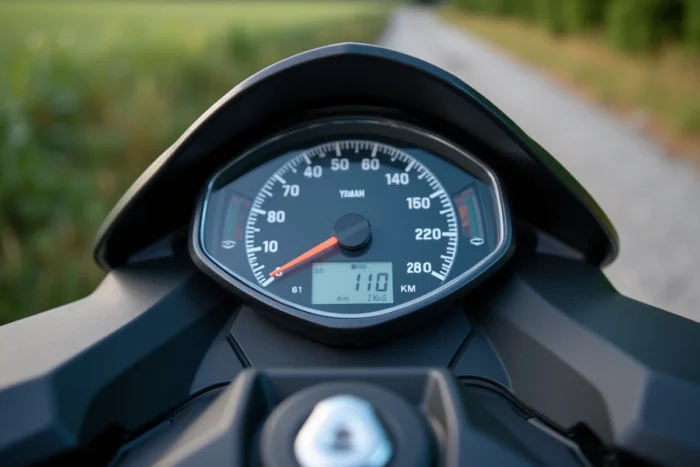
Before discussing break-in, a misunderstanding must be addressed. The speedometer reading of the Xmax 125 overestimates the actual speed, and this discrepancy widens beyond 100 km/h. A speedometer that indicates 115 km/h may correspond to a real speed measured by GPS around 105 km/h.
Have you ever compared your speedometer with a GPS app on your phone? The discrepancy is confirmed every time. Manufacturers intentionally calibrate their speedometers with a positive margin for regulatory reasons. The speedometer is not lying: it rounds up.
This point changes the interpretation of all testimonies on forums. When an owner claims to have “gained 10 km/h after the break-in,” the actual progression on GPS is often more modest. To honestly assess the max speed of the Xmax 125 during break-in, a GPS measurement remains the only reliable reference.
Xmax 125 during break-in: what happens in the engine during the first 1,000 km
The break-in is not a symbolic ritual. It is a concrete mechanical phase. The internal engine parts (piston rings, cylinder, crankshaft) have micro-irregularities on their surfaces when they leave the factory. During the first hundreds of kilometers, these surfaces adjust to each other through controlled friction.
Yamaha recommends varying engine speeds and avoiding prolonged full throttle during this period. The goal is simple: to allow the parts to mate without creating abnormal friction points.
In practice, this means that the new Xmax 125 does not deliver all its power. The maximum speed remains deliberately restrained. This is normal, and trying to force the engine to full throttle right from the first rides risks prematurely wearing parts that have not finished adjusting.
Signs that the break-in is progressing well
- The engine becomes smoother at mid-range, and the accelerations feel more pronounced without climbing in RPM
- Fuel consumption tends to stabilize after slightly fluctuating in the first weeks
- Vibrations at high RPM gradually decrease, indicating that the rotating parts are finding their balance
Max speed of the Xmax 125 after 10,000 km: a category ceiling
After the complete break-in and a few thousand kilometers of use, the engine reaches its optimal performance. The top speed stabilizes. The real gain between a new Xmax and a broken-in Xmax remains moderate: a few km/h on GPS, not a radical transformation.
This observation sometimes disappoints owners who hoped for a spectacular leap. The Xmax 125 remains an A1 category scooter, with a single-cylinder engine whose power is regulated. No break-in will transform a 125 into a machine capable of comfortably cruising at 130 km/h.
The usable ceiling in real conditions
The top speed on paper is one thing. The maximum speed usable daily is another. Solo, on flat roads and without wind, the broken-in Xmax 125 maintains a decent pace around 110 km/h on the speedometer. Add a passenger, saddlebags, or headwind, and this speed drops significantly.
This is a limit common to all 125 category scooters, not a flaw of the Xmax. Recent comparative tests between 125 scooters show that the power reserve for overtaking or maintaining a high speed with two people remains limited across all models in this engine size.
Maintenance and wear after 10,000 km: what influences speed
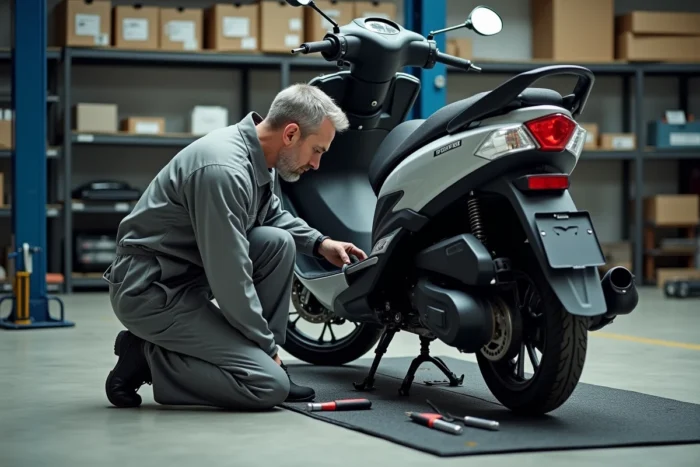
An Xmax that loses speed after 10,000 km does not necessarily age poorly. Several elements of normal wear directly affect peak performance.
- The variator roller wears with mileage. When it loses weight or roundness, the transmission does not reach as high in the gears, and the maximum speed decreases
- The drive belt stretches over time. A loose belt slips at high RPM and hinders speed increase
- A clogged air filter reduces air intake. The engine receives less oxygen, and combustion is less efficient
- Worn brake pads or a slightly sticking brake create a constant resistance, often imperceptible in the city but measurable at peak speed
Replacing these wear parts during the scheduled maintenance by Yamaha generally suffices to restore the initial top speed. A well-maintained Xmax 125 at 15,000 km performs as strongly as at 5,000 km.
The first oil change, a key moment
The break-in oil change (often scheduled early in the scooter’s life) removes microscopic metal particles generated by the polishing of internal parts. Skipping this oil change means letting the engine run in oil laden with abrasives. The consequences are not immediately visible, but they affect the engine’s longevity and, indirectly, the maintenance of performance.
The max speed of the Xmax 125 is not a fixed number: it evolves with the break-in, stabilizes, and then depends on regular maintenance. Measuring with GPS rather than the speedometer, respecting the break-in phase without excess, and replacing wear parts at the scheduled intervals are the three concrete levers to get the best out of this scooter over time.