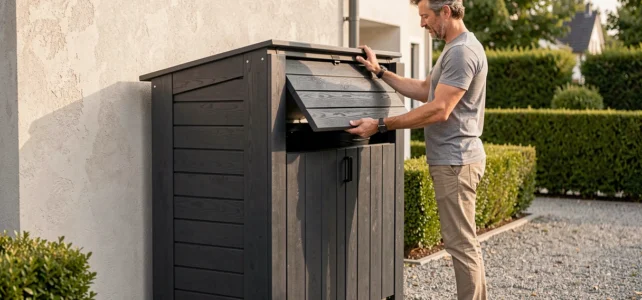
An outdoor trash shelter is no longer sized for just two bins. Since January 1, 2024, the source separation of organic waste requires each household to have an additional container, whether it’s a dedicated bin or a composter. This regulatory constraint directly modifies the specifications of a trash enclosure: capacity, modularity, ventilation. We recommend starting from this parameter even before considering the material or color.
Ventilation and management of organic waste in a trash shelter
Most trash shelters sold in DIY superstores are designed as closed boxes. This design poses a concrete problem as soon as an organic waste bin stays there for more than a few days, especially during the summer.
A shelter without air circulation accelerates fermentation and generates unpleasant odors. We observe that models with perforated walls or slatted panels limit this phenomenon by allowing a cross flow of air, without exposing the contents to direct weather conditions.
When evaluating an outdoor trash shelter at Brico Dépôt, check for the presence of side or rear openings. A completely airtight shelter is suitable for tool storage, not for organic waste containers.
The key point to decide: if your community provides a small-volume organic waste bin, a double shelter with an additional ground space is sufficient. If the bin is the same size as a standard bin, a triple model is necessary from the outset.
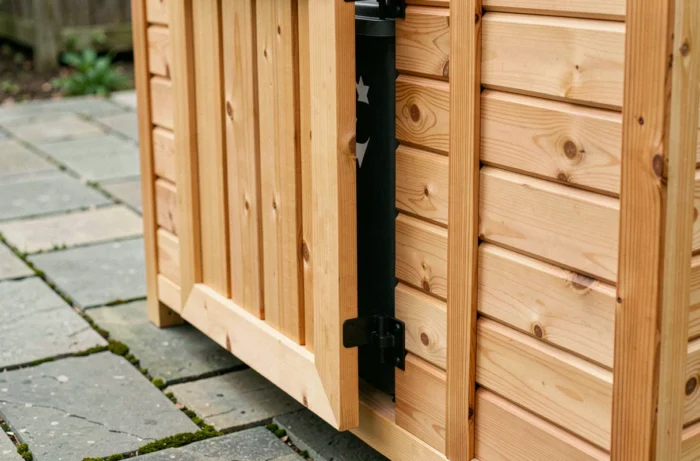
Galvanized steel, resin, or wood: which material for a durable trash enclosure
The choice of material determines both longevity and maintenance requirements. In this segment, three families dominate the catalogs of DIY brands.
Galvanized steel
Galvanized steel offers the best rigidity-to-weight ratio for a trash enclosure. Galvanization protects against corrosion without additional treatment in the first years. Models in anthracite gray easily integrate into a contemporary facade.
The downside: a localized impact (lawn mower passage, rough handling of the bin) can damage the zinc coating. A touch-up with anti-rust paint remains simple, but it should be anticipated.
Woven or molded resin
Resin does not rust, does not rot, and only requires a wash with water. Ranges like Keter, available at Brico Dépôt, offer fairly realistic wood-like finishes. The weak point is structural: resin deforms under prolonged thermal load if the shelter is exposed directly to the south without shade.
Treated autoclave wood
Wood remains the easiest material to customize (stain, paint, custom cutting). A trash shelter made of class 3 treated autoclave wood resists moisture without maintenance for several years. After this period, a coat of saturator is necessary to prevent graying.
- Galvanized steel: suitable for environments exposed to wind and rain, minimal maintenance except for mechanical impact.
- Resin: ideal for shaded or semi-covered locations, no regular maintenance required.
- Treated wood: to be favored when aesthetic integration is a priority (landscaped garden, proximity to a wooden terrace).
Sizing a trash shelter: 120 L, 240 L bins, and modularity
A common mistake is to measure the shelter based on the number of current bins without planning for future changes. However, communities regularly adjust collection volumes, especially with the increasing implementation of incentive pricing for household waste collection.
A modular shelter with removable partitions adapts better than a fixed model. Some triple trash enclosures can accommodate three 120-liter bins or two 240-liter bins with residual space for a composter or a collection bag.
Before ordering, measure the bins provided by your intercommunity. Sizes vary from one provider to another: a 240 L bin can measure between 55 and 65 cm wide depending on the manufacturer. Allow a margin of 5 cm on each side to facilitate handling.
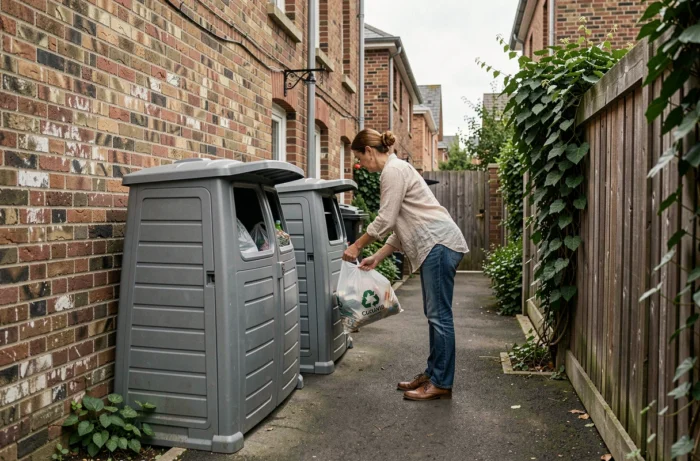
Access from the front or top
A shelter with a front opening (swing or sliding door) allows the bin to be removed without lifting it. This is the most practical configuration for 240 L wheeled bins. Top access, like a chest, is suitable for small containers but complicates the extraction of a heavy bin.
Local regulations and positioning on public roads
Several municipalities impose strict rules on the presentation of bins at the curb. Some prohibit leaving containers visible outside collection days, under penalty of fines. A stylish trash shelter solves this problem by concealing the bins while maintaining quick access on collection day.
Check your municipality’s road regulations before placing a shelter on public space or property boundaries. In subdivisions, the co-ownership specifications may also impose a specific color or type of material.
- Consult the municipal order on bin presentation: times for putting out, distance from the roadway, obligation to remove after collection.
- In co-ownership, the trash room or outdoor shelter may sometimes require the syndic’s approval before installation.
- On sloped land, plan for a leveling or concrete slab to stabilize the shelter and prevent bins from rolling upon opening.
The choice of an outdoor trash shelter ultimately hinges on three technical parameters: the number of bins to accommodate (including organic waste), the material suitable for the exposure of the location, and compliance with local rules for container presentation. A well-sized model from the outset avoids premature replacement as sorting obligations continue to evolve.