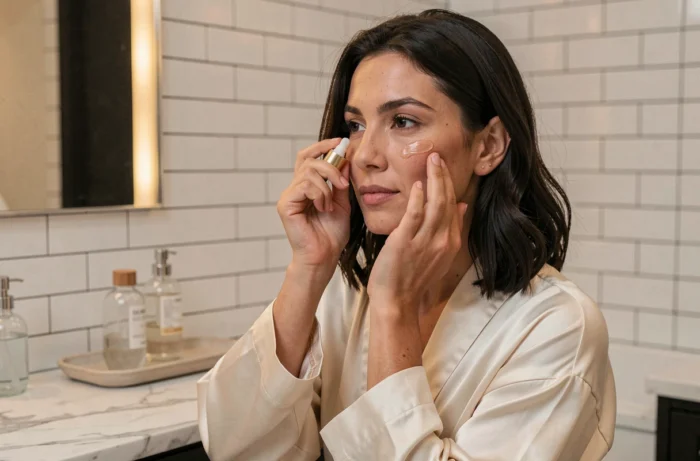
A beauty routine in 2026 is first and foremost a balancing act between the number of products, their ingredients and their price. Facial skincare sales in mass-market retail fell in 2025, and the average price per item also declined, according to panel data cited by Businesscoot.
At the same time, Law No. 2025-188 has prohibited cosmetics containing PFAS above the regulatory threshold in France since January 1, 2026. Together, these two developments are reshaping how we choose the products we use every day.
PFAS and reformulation: what Law No. 2025-188 means for your cosmetics
PFAS, or per- and polyfluoroalkyl substances, were used as texturizing and setting agents in foundations, mascaras and some long-wear creams. Since January 2026, their presence above the threshold set by law has been prohibited in cosmetics sold in France.
In practice, this means that familiar formulas may have changed without any visible notice on the packaging. If a foundation’s texture or staying power differs from the previous version, it is not necessarily a manufacturing defect: it is often the result of reformulation to comply with regulations.
Two simple habits can help you spot these changes. Compare the INCI list (the mandatory ingredient list) on an older product with the current version. Also check brands’ official communications, as they sometimes announce changes on their websites or social media. Specialist resources bring this information together, such as https://www.cosmetiques-beaute.net, which covers beauty and cosmetics news.
In October 2026, the European Parliament also reached a provisional agreement on simplifying cosmetics and labeling rules at the European level, but the text still needs to be approved by the Council. No new requirements apply for now.
Skinimalism and budget constraints: two approaches not to confuse
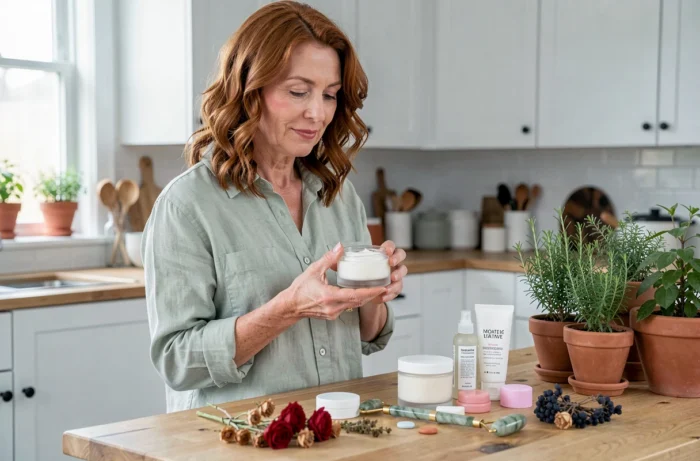
Skinimalism is an approach that pares skincare down to a few multifunctional products. In theory, it is a choice made for your skin: fewer layers, less risk of ingredients clashing, and less strain on the skin barrier.
At the same time, financial pressures are also leading people to buy less. Circana data reported by LSA show that skincare sales in selective perfumery declined in 2025. The average price per item also fell, according to Worldpanel data cited by Businesscoot. Cutting back on your routine for dermatological reasons is not the same as doing so to save money.
The distinction matters because it changes what you look for:
- A skinimalist approach prioritizes ingredient compatibility and formula quality, even if that means investing more in a single, well-dosed serum.
- A budget-conscious approach seeks the best value for money and turns to outlets such as pharmacies or mass-market retailers, where prices are lower.
- A safety-first approach checks regulatory compliance first (no PFAS and a transparent INCI list) before comparing textures or marketing claims.
Confusing these three approaches can mean dropping a useful product to save money, or buying a reformulated product without understanding why its texture has changed.
Targeted ingredients and hydration: building a well-balanced skincare routine
Beauty trends in 2026 converge on one point: consumers want recognizable active ingredients whose purpose they understand. Opaque “patented complexes” are losing ground as demand grows for greater transparency.
Three ingredient groups dominate today’s routines. Hyaluronic acid remains the go-to for surface hydration. Niacinamide (vitamin B3) targets uneven skin tone and sebum production. Ceramides strengthen the skin barrier, a goal featured in all recent dermatological recommendations.
Layering active ingredients without canceling them out
The most common pitfall in a multi-active routine is combining retinol with exfoliating acids (AHAs, BHAs). Applied at the same time, they weaken the skin barrier instead of strengthening it. The recommended approach is to alternate them: exfoliate in the evening, use retinol the next day, and always apply a moisturizer as a buffer.
A well-chosen serum can often replace two or three layered products. A serum combining niacinamide and hyaluronic acid addresses hydration and even skin tone in a single step. This is exactly the overlap between skinimalism and effectiveness that consumers are looking for today.
Where to buy cosmetics: pharmacies, selective perfumery and mass-market retailers
Your choice of retailer directly affects the types of products available to you. According to an April 2026 Xerfi study reported by Carmel Cosmetics Labs, purchases are shifting toward pharmacies, while some segments are slowing in selective perfumery.
This shift is not purely economic. Pharmacies offer brands whose formulas are often validated through dermatological testing protocols. Advice from pharmacy staff adds a layer of personalized guidance that neither e-commerce nor mass-market retail can easily replicate.
In mass-market retail, declining facial skincare sales in 2025 are prompting retailers to curate their ranges. More focused selections, with products clearly identified by skin type or active ingredient, are gradually replacing vast, encyclopedic shelves.
Solid and refillable formats for everyday use
Beyond makeup and facial skincare, solid and refillable formats are also gaining ground in everyday personal care (soaps, shower gels), according to Eurostat Comext 2024–2025 data compiled by Businesscoot. This trend reduces the amount of plastic packaging per use, but it is important to check how well the product keeps: a solid shampoo stored improperly in a damp shower will deteriorate faster than a conventional bottle.
Adapting your beauty routine in 2026 means accepting that the perfect product of yesterday may have a different formula today. Checking an INCI list takes thirty seconds. It is the most worthwhile habit you can add to your routine.