
A gently sloping plot, facing south, with an unobstructed view of the valley: on paper, the property ticks all the boxes. On the ground, the parcel is located in a high-risk area for clay shrink-swell, and the foundations already show microcracks. On the hillsides, the soil influences profitability as much as the view. Identifying a promising real estate investment in this type of terrain requires cross-referencing geotechnical, urban planning, and rental signals.
Shrink-swell of clays on the hillsides: the risk that redefines the market
Since July 1, 2026, a new national map of clay soils has become an official tool for real estate sales. The obligation to inform buyers in areas exposed to clay shrink-swell (RGA) changes the game for houses located on slopes and hillsides, where this phenomenon is particularly active.
The numbers speak for themselves: 55% of French territory is now classified as medium or high risk, compared to 48% in the previous 2020 map. For an investor, this means that an increasing proportion of properties on hillsides fall into a category that complicates resale and increases insurance costs.
Before any visit, one should consult the Géorisques portal to check the RGA risk level of the parcel. A property located in a low or no risk area on a hillside retains a net comparative advantage over neighboring parcels classified as high risk. This is a quick sorting criterion, and it allows you to consult echangeimmo.com for investment by targeting the least exposed sectors.
Slope, orientation, and urban planning: the physical parameters of a profitable hillside
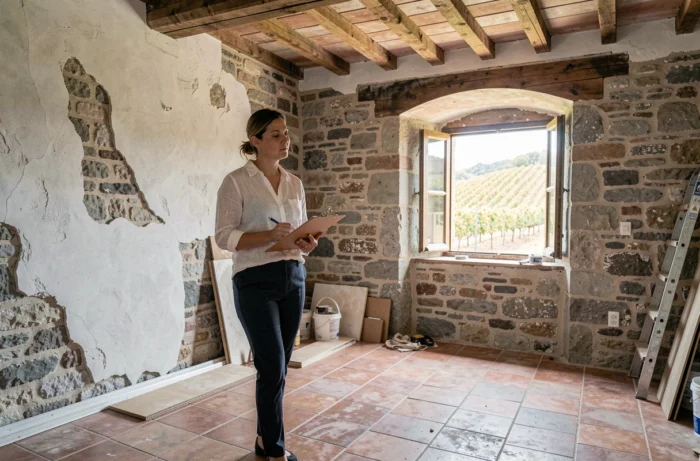
A hillside is not a flat piece of land with a slope. The slope generates construction constraints (earthworks, retaining walls, stormwater management) that directly impact the acquisition price and the renovation budget of an older property.
Orientation and sunlight
A south or southwest-facing slope captures more light, improving thermal comfort and reducing heating costs. Conversely, a north-facing hillside in an already damp area accumulates disadvantages: prolonged frost risk, persistent humidity on facades, and lower rental attractiveness.
Urban planning documents to check
The Local Urban Plan (PLU) may impose specific restrictions on sloped areas:
- Reduced ground coverage coefficient, which limits possibilities for extension or parcel division
- Areas classified as natural risk (landslide, runoff), where building permits are conditioned on a geotechnical study
- Landscape protection perimeters that prohibit certain modifications to facades or roofs, hindering value enhancement through renovation
A restrictive PLU on a hillside is not a dealbreaker, but these constraints must be factored into the profitability calculation. A property whose expansion potential is blocked by urban planning regulations is mechanically worth less than a comparable property without restrictions.
Rental signals and neighborhood dynamics on a hillside
Residential hillsides often attract stable tenant profiles: families, executives, active retirees. Rental demand here is less volatile than in student city centers, but the turnover rate is also lower. Therefore, one seeks a balance between low vacancy and sufficient rent to yield a reasonable return.
What to observe before buying
Rather than relying on average price per square meter for an entire municipality, one isolates the micro-market of the hillside. Price differences between the lower and upper parts of the same slope can be significant, depending on road accessibility, proximity to shops, and the quality of transport services.
A hillside well-served by a main road with shops within ten minutes retains its value even during market slowdowns. Conversely, an isolated area accessible only by narrow and steep roads is more susceptible to price corrections.
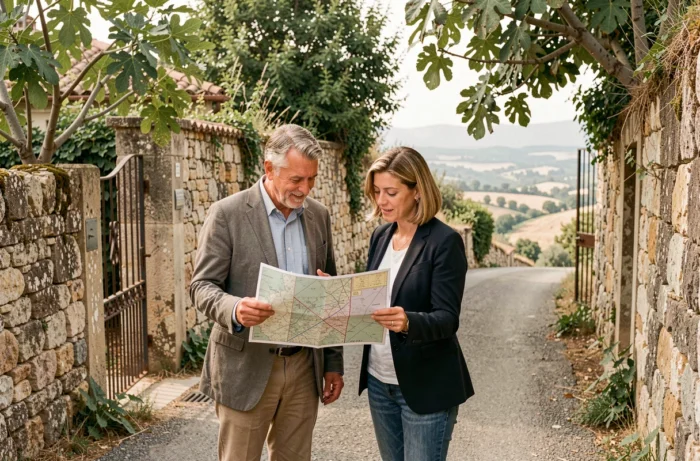
Municipal development projects deserve special attention. The creation of a pedestrian path connecting the hillside to the city center, the installation of a shuttle stop, or the rehabilitation of an old building into a local business are concrete signals of future value enhancement.
Real acquisition cost on a hillside: the items that listings do not show
The listed price of a house on a hillside often conceals additional costs related to the terrain. These should be identified in advance to avoid turning a promising investment into a financial pitfall.
- Geotechnical study G2 (mandatory in areas of medium or high RGA risk for new constructions, strongly recommended for older properties): its cost varies, but it may reveal the need for underpinning work that represents several tens of thousands of euros
- Individual sanitation: on hillsides not connected to the sewer system, the slope complicates the installation of a compliant sanitation system, and bringing it up to standard may condition the sale
- Drainage and stormwater management: a poorly drained sloped plot leads to infiltrations that degrade foundations. Returns vary on this point depending on soil type, but a visual diagnosis of the basement walls (signs of moisture, efflorescence) already provides an indication
An informed investor budgets these items before negotiating, not after signing the preliminary agreement. On a hillside, the margin for negotiation is often wider than on flat land, precisely because these constraints deter uninformed buyers.
The hillside real estate market rewards those who read the soil before looking at the view. A property with healthy land, a favorable PLU, and improving access constitutes a solid investment, even in a wait-and-see market context. The key remains to treat each parcel as a unique case, not as a line in an average rental yield spreadsheet.